


Whether children are out of school, at risk of dropping out, or struggling to stay engaged in formal classrooms, the challenge of keeping every learner in education is widespread. For the millions of children and youth who are not in school, accelerated education programmes (AEPs) have proven to be an effective approach to catch learners up on foundational skills and integrate them into formal education. AEPs are flexible, age-appropriate programmes, run in an accelerated timeframe, which aim to provide access to education for out-of-school children and youth (see our note on terminology on page 3). While they have proven effective in many contexts, not all AEPs have positive results, and many AEP learners get lost in the transition to formal schooling.
Education.org’s (2022) AEP synthesis identified nine characteristics of effective AEPs, centring on government ownership and the need to embed AEP policies and guidelines into the formal school architecture. This (2025) Transitions synthesis completes the story, adding a tenth characteristic that is a crucial lever of success for all AEP models and transition pathways, especially those to formal schooling: close collaboration between AEPs, formal schools, and communities. It presents the STEP Framework, for Supporting Learners Through Evidence-based Planning (STEP), which follows the AEP learner on their transition journey, not just until they enter formal school, but ensuring they thrive within it (see image below).
By breaking the learners’ transition journey into five distinct stages, the STEP Framework highlights where the evidence points to the greatest challenges and the most effective strategies to facilitate the long-term success of learners. These five stages, which each have associated evidence-based actions, are underpinned by one foundational (or cross-cutting) action: close collaboration between AEPs, schools, and communities.
This report is meant to be used together with our high-level guidance and STEP planning tool, which will help education leaders prioritise which stages and associated actions are most relevant for their local contexts and operational realities. Both this synthesis report, and the accompanying high-level guidance, are anchored in the most comprehensive AEP evidence base to date, collected and analysed through Education.org’s pioneering approach to evidence synthesis—LIFTED or The Locally Inclusive Framework for Transforming Evidence into Education Decision-Making. LIFTED distils the most relevant, high-quality evidence from a wide range of sources, including academic studies, government documents, and programmatic reports. To determine relevance and quality, all sources were rigorously assessed against a set of criteria tailored to the synthesis questions, analytical framework, and geographical contexts of focus.
Over 11,000 sources were screened, 387 sources spanning 68 countries were analysed, and 151 of these sources were selected for deeper analysis through the LIFTED appraisal tool. To complement this work, we conducted a policy mapping of 60 national or subnational education sector plans in countries with active AEPs, and validated programmatic data with 16 donors, spanning 171 AEPs across 50 countries. Additionally, key informant interviews were conducted, and case studies co-developed with policymakers, practitioners, researchers, and donors. All insights were validated with AEP stakeholders through various rounds of consultation, review, and iteration. In total, more than 70 organisations, including government agencies, international and local non-governmental organisations, bilateral and multilateral organisations, researchers, and donors contributed to this report.
This research responds to an urgent request from education leaders who—following our AEP (2022) synthesis and guidance—expressed a need for evidence-based strategies to facilitate learners’ transitions from AEPs to formal primary or secondary school. While the target audience for this synthesis is primarily technical specialists within governments, its accompanying high-level guidance is meant for Ministers and non-technical specialists to easily access evidence-based strategies for decision-making. The evidence-based solutions described are also relevant for other non-formal education models, and for ensuring all learners—AEP graduates and their peers—achieve lifelong learning and thrive in schools and society.

The STEP Framework
Introduction
Why developing foundational skills at speed is so critical today
The global education crisis is more urgent than ever. An estimated 272 million children and youth are not in school today, representing 21 million more compared to estimates just two years ago (UNESCO, 2025).[1] Through renewed commitments to the Sustainable Development Goals (SDGs), countries have committed to reduce the number of out-of-school children and youth (OOSCY) by 165 million by 2030 (Ibid). Likewise, SDG 4 calls for inclusive, equitable, and quality education for all children and youth, with a focus on foundational skills. But 70% of children worldwide are unable to read a simple text (World Bank, 2022).
The compounding effects of poverty, conflict, the COVID-19 pandemic and environmental disasters push millions further from learning (UNESCO, 2020; Patrinos, 2023). Young people with disabilities, ethnic minorities, migrants, or those who are forcibly displaced experience stigma, discrimination, and increased risks of adversity and trauma, which directly impact their access to quality learning opportunities (UNESCO, 2020). And both girls and boys face unique barriers due to deeply entrenched gender norms - from child labour to domestic responsibilities to gender-based violence.
The learning crisis costs the global economy an estimated USD$10 trillion per year (UNESCO, 2024b). Yet investments in education, both domestic and foreign aid are declining. Government education spending, as a percentage of gross domestic product, has remained largely unchanged in all country income groups since 2010—except for low-income countries (Poulsen, 2022). At the same time, low-income countries, where an average 17% of all education spending comes from foreign aid (up to 50% in some countries), are being severely impacted by cuts in overseas development assistance (GEM Report, 2025). From 2023 to 2027, aid to education is projected to fall by a quarter, hitting low-income countries the hardest, with some expected to lose as much as half of current aid levels (ibid).
While cuts have been widespread, from the US to Europe, the decline in funding from the UK alone is expected to push 2.2 million more children out of school (Wagner, 2025). Marginalised groups—such as girls, refugees, and learners with disabilities—bear the brunt of this (ETF, 2025; Send My Friend to School Coalition, 2025). Climate change and conflict put pressure on countries already constrained by a scarcity of resources. These challenges are further exacerbated by fragmented governance systems, inefficient use of resources, and policies that do not adequately address the deeply rooted structural barriers that hold systems and learners back.
Without urgent action and renewed commitment, entire generations will be left without the skills needed to thrive in school, work, and society. Investing in foundational learning for all closes equity gaps and offers governments some of the strongest long-term returns, including higher earnings, lower unemployment, better child health, and broader economic growth (Kaffenberger et al., 2025). Without rapid interventions, learning gaps widen and become increasingly difficult to remediate over time, further exacerbating inequalities (Kaffenberger, 2021). Each year of delay translates into reduced lifetimes earnings and diminished national productivity, with the steepest losses borne by disadvantaged communities (Hanushek & Woessman, 2020). Well-designed flexible education options can help mitigate barriers to equity by providing age-appropriate, accelerated routes back into formal education (Shah & Choo, 2020; Grant Lewis et al., 2022). Education leaders need evidence-based cost-effective and scalable solutions that reach the furthest behind, including practical guidance on how to support equitable transitions into formal school.
Why an education knowledge bridge is urgently needed
Solutions exist. A growing body of evidence demonstrates what works to support learners in developing foundational skills and thriving in school. A key challenge, however, is that these solutions are not always easy to find. An estimated 80% of education research is not published through traditional peer-reviewed processes (Education.org, 2021).[2] Yet peer-reviewed literature—often found in academic journal articles and books—is valued as the gold standard of evidence, despite being highly dominated by researchers in and contexts of the Global North (OECD, 2025; Brun et al., 2024).
While peer-reviewed research can provide robust foundations, it can be difficult for education leaders to use in practice. Articles may sit behind paywalls or be presented in technical formats, and findings do not always align with local priorities (Education.org, 2021). As a result, decision-makers may lack timely, practical insights. Even when evidence is available, it is often highly technical or not adapted to context, and it can arrive after key decision windows.
This evidence synthesis addresses this gap. It was produced in response to an urgent request by education leaders in countries implementing accelerated education programmes. Building on our previous AEP synthesis (Grant Lewis et al., 2022) and subsequent consultations held with policymakers, implementers, and donors from across more than twenty organisations, this Transitions synthesis answers the question: What evidence-based solutions can education leaders use to support learners to transition from accelerated education programmes to formal primary or secondary schools?
Drawing on the most comprehensive AEP evidence-base to date and grounded in Education.org’s user-centred synthesis methodology, it distils the most relevant and high-quality evidence, including academic studies, government documents, and programmatic reports. It draws on a screening of over 11,000 sources, 387 of which were identified as relevant, and 151 which were selected for deeper analysis and form the focus of this report. Expanding beyond peer-reviewed literature has helped us capture a broader and deeper understanding of accelerated education and its relationship with formal schooling, particularly in contexts of crisis and fragility. We have also been able to include more voices and experiences of marginalised groups of learners, such as girls, refugees, youth, and learners with disabilities, and included a significantly higher number of publications authored by researchers and institutions based in the Global South (Education.org, 2025).
A note on terminology:
The focus of this report is on accelerated education programmes that meet three criteria: they deliver a curriculum in an accelerated timeframe, target out-of-school children and youth, and provide pathways back into the formal education system. While we use the term accelerated education programmes (AEPs), we identified over 25 terms used to refer to these education models globally, including accelerated learning, bridging or gateway programmes (particularly in Francophone West Africa), catch-up classes, complementary or community-based education,[3] equivalency programmes, or alternative learning systems (as well as programme specific names, such as Speed School in Ethiopia and Uganda or the Second Chance programme in Liberia). These programmes all deliver a curriculum in an accelerated timeframe and target out-of-school children and youth. Some of these programmes also target students in school (especially in Latin America), and offer additional transition pathways, such as those to further skills and vocational training, apprenticeships, self-employment, or formal employment. While the focus of this synthesis is on AEPs that support re-entry into formal schooling, several insights presented may also apply to these adjacent pathways.
Accelerated education as a pathway to formal schooling and sustained learning
Accelerated education programmes (AEPs) are ‘flexible, age-appropriate programmes, run in an accelerated timeframe, which aim to provide access to education for disadvantaged, over-age, out-of-school children and youth’ (INEE AEWG, 2016). AEPs offer a potential low-cost model to help out-of-school children and youth (OOSCY) catch-up in their learning and return to school. However, while research has largely shown that AEPs help students develop foundational skills, there has been less focus on transition opportunities available to them after they finish an AEP. Indeed, five years ago, a review of AEP evidence (Shah & Choo, 2020) identified a striking paradox in relation to accelerated education programmes: rising AEP enrolment rates were rarely matched by successful post-AEP transitions to formal primary or secondary school.
To fill that gap, this report presents six key evidence-based insights to ensure the successful transition of AEP learners into formal school. A successful transition is defined as an AEP learner not only entering formal school but also at least finishing their first year of schooling. The evidence-based insights make up the Supporting Transitions for Evidence-Based Planning Framework (or STEP Framework). The STEP Framework follows the AEP learner on their transition journey and breaks that journey into five stages: from their time learning in an AEP (Stage 1), to completing an AEP through a final assessment (Stage 2), to accessing a formal school (Stage 3), enrolling in it (Stage 4), and completing their first year of schooling, so they can progress within the formal education system until completion (Stage 5). These five stages—each with their own evidence-based risks and mitigation strategies—are underpinned by the sixth insight: the importance of collaboration amongst AEP, formal school, and community stakeholders. These insights are relevant for broader non-formal education systems that seek to transition OOSCY into formal education systems, as well as transitions within formal education system from one grade to the next. The STEP Framework can also be tailored for AEPs transitioning to alternative pathways beyond school, with contextual adaptation particularly where credentialing, placement, and progression requirements differ (see Insight 3).
The next section of the report briefly describes the approach used to source and analyse evidence in order to bring frontline experiences from a wide range of LMICs to light. This is followed by a brief summary of our previous AEP synthesis and a presentation of the STEP Framework for Supporting Transitions through Evidence-Based Planning: five stage-specific insights with associated actions and one foundational action that underpins them. Additional cross-cutting issues are examined, such as the importance of robust data and monitoring systems, sustained financing, and a focus on equity to ensure the needs of all marginalised learners are fully addressed. The final section concludes with a call for future research, based on the identified evidence gaps. Importantly, the target audience of this report is technical specialists, especially those working directly within governments to support policy- and broader decision-making. Secondary audiences include researchers and donors. Non-technical specialists are encouraged to view our accompanying high-level guidance, which summarises the key insights and evidence-based strategies in an eight-page brief.
Research Methods: LIFTED is a systematic and inclusive approach to evidence synthesis
Education.org’s Locally Inclusive Framework for Transforming Evidence into Education Decision-Making (LIFTED) is an innovative systematic and user-centred approach to evidence synthesis. The approach begins by identifying pressing policy needs and evidence gaps in consultation with education decision-makers and evidence users, crafting relevant policy questions, hypotheses, and an analytical framework. Then LIFTED intentionally seeks out the most relevant, high-quality evidence to answer the question, extending beyond peer reviewed literature which tends to be the focus of most evidence syntheses. By doing so, LIFTED captures more evidence, including insights generated by local researchers, implementers and policymakers, and those focused on marginalised learners, such as girls, refugees, youth, and learners with disabilities (Education.org, 2025a).
A diverse group of education decision-makers and evidence-users, including policymakers, implementers, donors, and researchers, from more than 70 organisations were engaged at various stages and in different capacities, to ensure our approach aligned with their needs. Actions included initial scoping discussions to identify evidence gaps and co-develop the research questions, crowdsourcing the most recent and relevant evidence (including evidence only accessible through direct outreach or personal communication), and workshopping initial and final insights and outputs (including this report and our accompanying high-level guidance).
Identifying the synthesis question
This synthesis emerged from an explicit need and request of education leaders working in LMICs, in development and humanitarian contexts. Following Education.org’s (2022) AEP synthesis, education leaders described a need for evidence-based actions to facilitate learners’ transition from non-formal education systems to formal schools, as well as within the formal education system. To further define and clarify the scope of our next synthesis, in late 2023, we held formal consultations (virtual and in-person) with more than 40 stakeholders from approximately 35 institutes/organisations, including government agencies, multilaterals and bilaterals, international and national NGOs, and research institutes or universities. Most of these organisations support AEPs in sub-Saharan Africa, with many supporting AEPs that span multiple continents. 4
The information collected during these consultations was analysed and informed the development of a comprehensive issues tree 5 that mapped barriers and enablers to learners who transition from accelerated education to formal primary or secondary school. This issue tree would shape the research questions, hypothesis and analytical framework.
The analytical framework developed was an earlier version of the STEP Framework, which breaks down the learners’ transition journey into five stages. This framework served as an analytical tool, and was adapted iteratively as new evidence and insights were captured. Barriers and enablers to transitions within the STEP Framework were mapped across an adapted socio-ecological framework (Bronfenbrenner, 1978).
Approach to sourcing evidence
Recognising that valuable insights are often found outside of peer-reviewed publications, our LIFTED approach builds on the work of the International Working Group (IWG), to source and quality-assure a wide range of evidence. Drawing on the landscaping report that informed the IWG (Education.org, 2023), we define “evidence” as the most relevant and highest-quality available information to inform decisions in LMICs and crisis-affected countries, encompassing both rigorous research studies and, where appropriate, systematically appraised non-research sources (e.g. practitioner or expert consensus—such as conference hearings or the results of stakeholder meetings—policy and programme documents, literature reviews, and other evidence source often referred to as grey literature 6) that illuminate both what works and how, why, and for whom (see also Aromateris & Munn, 2020; Glasofer & Townsend, 2021). We include non-research only when it meets explicit relevance and quality criteria and is triangulated with other sources, so that expert opinion and firsthand experiences complement and add depth to—rather than substitute—scientific research. 7 While this section briefly summarises our approach to sourcing evidence, a more detailed methodology can be accessed on Education.org’s website.
A phased approach was used to source evidence over a one-year period (from December 2023 to 2024). A combination of desk-based research and targeted crowdsourcing was used. Two ‘calls for evidence’ were distributed through social media (LinkedIn) and to our vast professional networks (by e-mail): the first was a general call for evidence, and the second was more targeted, in attempt to fill several identified evidence gaps from the initial stages of data analysis.
Over 11,000 sources were screened against inclusion criteria. 8 To be included, the source must:
- Be published in 2016 or later, in English, Spanish, French, Portuguese, or Arabic 9
- Take place in an LMIC or a country affected by conflict or crisis 10
- Have evidence on an AEP that: (1) delivers a curriculum in an accelerated time frame, (2) targets school-aged learners who are not in school, and (3) offers transitions to formal primary or secondary school.
Importantly, this means AEPs that only target learners in school, or that only offer learners transitions to vocational training or employment were not included. 11 However, evidence was analysed on alternative transition pathways, when they were offered in addition to transitions to formal primary or secondary school. Also out of scope are AEPs in which learners complete their education (as these do not offer transition pathways back into formal education), as well as AEPs offered for adults. 12 Major limitations of the study include: programmes often reporting contradictory or piecemeal evidence and information, and many AEPs operating under multiple names or acronyms, making it difficult to confirm whether a programme fit the scope of our research (see our AEP programmatic map in Annex 4 for more).
A total of 387 sources of evidence were included. All 387 sources were analysed through a built-for-purpose coding framework, identifying barriers and enablers to transitions across the STEP Framework and whether the source focused on marginalised groups of learners, based on gender, displacement, disability, or other characteristics. The coding framework also captured the source’s geographical focus, the location and type of authoring institution (e.g. whether an academic, NGO, bilateral, or multilateral, etc.), and the type of source itself (e.g. journal article, report, policy document, etc.).
Selection, appraisal, and analysis of sources
The 387 sources were analysed using Education.org’s LIFTED appraisal tool, which seeks to capture the most relevant, inclusive, and quality evidence. 13 Of the 387 sources assessed, 151 (or 39%) were selected for deeper analysis. Of the 151 sources selected, the most common were programme evaluations and case study reports (38%), followed by research briefs (19%) and peer-reviewed sources, such as journal articles, books, or dissertations (18%). About a quarter of sources selected for deeper analysis were literature reviews (10%), programme documents drawing on monitoring and evaluation data and broader lessons learned from implementation (7%), policy documents such as education sector plans or analyses (3%), or other types of sources (5%), including blogs, presentations, or newsletters that summarise research or insights emerging from virtual webinars and in-person events in which research were presented and socialised amongst stakeholders. Use the interactive pie graph below to explore more information about these sources (Figure 1).

More than a third (36%) of the sources selected for deeper analysis employed a mixed methods research design, while approximately 21% were qualitative, and 13% were desk-based, and only 7% were quantitative empirical studies. The rest, or approximately one-quarter of all sources selected for deeper analysis (23%) were ‘other’ types of sources of evidence, not providing original empirical data, but rather repackaging research findings, and providing additional programmatic data, statistics from government offices, or lessons learned from implementation. Amongst the quantitative and mixed methods studies were 49 evaluations, and 22 experimental or quasi-experimental studies (e.g. randomised control trials or tracer studies). Use the interactive pie graph below to explore more on the different research methodologies and other types of sources selected for deeper analysis (Figure 2).
Of the 68 countries from which evidence was collected, 40 were captured through our LIFTED approach—countries that would likely have been exclude by synthesis methods relying only on peer-reviewed literature. In many of these 40 countries, however, the evidence base remains thin, often limited to fragmented monitoring and evaluation data or highlighting challenges rather than solutions. Overall, the evidence covered all world regions except the Caribbean. The absence of evidence in the Caribbean is likely due to there being no active accelerated education programmes in the subregion. Indeed, most sources came from sub-Saharan African contexts, with nearly half of all sources selected for deeper analysis (70 of 151) coming from Ghana, Nigeria, Ethiopia, or Uganda alone. Three countries from South Asia were also amongst the top countries with quality evidence: Nepal, Pakistan, and Afghanistan (see the interactive map below). Most countries with evidence were LMICs, with some evidence coming from upper-middle income countries in Latin America (especially Colombia and El Salvador). It should also be noted that in nearly three quarters of the countries (48 of 68), we found only three or fewer sources of quality, relevant evidence, selected for deeper analysis.
Accompanying case studies and AEP maps
Case studies and a mapping of AEP programmes and policies accompany this synthesis:
- Case studies, co-developed with practitioners, researchers, and government officials, delve deeper into insights not fully captured in the evidence base. These can be found online in our ‘Insights for Action’ series.
- A mapping of 188 programmes across 59 countries (170 of which have data validated by 16 donors), and an analysis of 60 national or subnational ESPs in 50 countries with active AEPs.
Validation of insights with education leaders
Initial insights were validated with a diverse group of education leaders, including some stakeholders who had been engaged in the previous scoping and identification of the synthesis question. Consultations were held virtually and in-person with 39 education leaders, including policymakers, practitioners, researchers, and funder partners from 27 organisations working on AEPs in 40 countries. These conversations (held in November 2024) informed further refinement, and a new set of insights were validated once again in May and June-July 2025 with 15 organisations (some previously and some newly consulted). These conversations led to one more round of revisions of both our synthesis and high-level guidance document (in August 2025). The first full draft of the synthesis was also shared with three external reviewers (two researchers, one practitioner).
The insights emerging from the full synthesis are described in the following sections, and the case studies and AEP mappings (also available on our website) are integrated to bolster the findings throughout. We also integrate evidence published in 2025 (i.e. after we finished coding the initial 387 sources), to ensure all insights are updated with the most recent evidence.
What do we know about AEPs and transition pathways?
For the purpose of this report, ‘successful’ transitions are defined as a learner’s ability to not only enrol in formal school, but also to complete the first year of schooling once they enrol. Very few studies indicate whether AEP graduates complete the grade they enter, while demonstrating the expected learning outcomes for that grade, and being retained within the system. The absence of clear definitions of ‘transition’ also makes it difficult to compare across studies. This section summarises some of the evidence to illustrate general trends. While it is not an exhaustive compilation of all available quantitative evidence, it can be used in parallel with the interactive map below to explore the most relevant, high-quality evidence identified.
AEPs often lead to learning but what about transitions?
AEPs have proven effective at helping out-of-school learners catch-up on foundational learning in a short amount of time. Often drawing on Early Grade Reading Assessments (EGRA) and Early Grade Math Assessments (EGMA), randomised control trials and quasi-experimental studies from the Democratic Republic of Congo (DRC) (Valenza, 2018), Liberia (McManus et al., 2024), Niger (Kielland et al., 2024), Nigeria (Díazgranados-Ferráns et al., 2022) and Nepal (Bhatt & Shreshta, 2022b), found that learners who study in AEPs improve significantly in foundational literacy and numeracy, often surpassing their peers in formal school. In Liberia, for example, an evaluation of Luminos Fund’s AEP indicates that, despite starting at lower learning levels than their peers in formal schools, AEP learners were able to read 4.5 times as many words per minute and complete 2 times as many addition and subtraction problems after participating in the 10-month programme (McManus et al., 2024). Similar impacts were seen regardless of learners’ gender, age, or prior educational experience and learning levels, meaning all learners benefited equally (Ibid).
This learning equips OOSCY for re-entry to formal education, often enabling them to catch up with their peers and advancing more efficiently through higher grades. For example, from 1995 to 2020, Ghana’s Complementary Basic Education (CBE) programme enrolled over 500,000 out-of-school children, with 90% transitioning to formal schools, and higher transition rates for girls (Associates for Change & IDRC, 2021). Since 2011, the Speed School programme in Ethiopia has reached an estimated 2.5 million children with 90% of learners successfully transitioning. 14 A longitudinal study tracking Speed School graduates found that these learners scored 10% higher in Math, 13% higher in local language literacy, and 7% higher in English than their counterparts in formal schools (Akyeampong et al., 2018). Speed School students also observed higher retention rates, with about 75% of all the former Speed School students tracked six years after transitioning still in school, compared to 61-66% of their peers (Ibid). Similarly, in Uganda, Speed School has reached more than 60,000 out-of-school children in its first seven years of operation, with 90% transitioning successfully to formal classrooms upon completion (Geneva Global, 2023). Between 58 and 76% of all learners who transitioned from Speed School classes five or six years later were still in school, with retention rates higher than their peers (Kyeyune et al., 2023).9
AEPs have impacted more than just learners’ academic skills, they have helped young people to develop important life skills, setting them up for success after school. Many programmes have highlighted the transformative power of life skills and social-emotional learning, with AEP learners developing competencies such as communication, conflict resolution, and critical thinking (e.g. Senegal: Contreras Gómez, 2024; Uganda: Kyeyune et al., 2023). Evidence from Girls Education Challenge (GEC), for example in Malawi, Nepal, Pakistan, and Zimbabwe, demonstrate how AEPs have improved girls’ understanding of their rights, healthy decision-making, gender-based violence, sexual and reproductive health, and more (GEC & UKAID, 2023; Bhatt & Shreshta, 2020a/b; Glow Consultants Ltd, 2022; Melville et al., 2023). In many of these cases, programmes targeted the most marginalised girls, including those who married early, young mothers, girls with disabilities or from ethnic minority groups (Rose et al., 2024). These skills equip marginalised learners not only for formal school, but also for transitions to further skill and vocational training or employment.
While there is limited comparable transition data, the available examples suggest transition rates vary greatly. Across 40 programmes presenting transition data, we found that transition rates ranged from 3% to 90%. Low transition rates may reflect an under-reporting, because many systems do not consistently track individual learners moving from non-formal programmes into formal schooling, as found in Pakistan (AAN Associates & UNICEF, 2022). Oftentimes, ‘transition’ is not defined, so it is unclear how it is measured (e.g. Somalia: Pereznieto et al., 2017; Kenya: Ngindiru et al., 2022). Other times, high transition rates reflect intent to transition, eligibility to transition (i.e. completion of an AEP or non-formal programme) or enrolment in formal school (e.g. Malawi: GEC & UKAID, 2023; Mali: Kebede, 2018). Very few studies report whether learners complete their first year of schooling, and those that do suggest many learners do not successfully transition.
Not all AEP learners transition successfully, and those who do often drop out or repeat grades. For example, data from UNICEF’s Let us Learn programme found that in Nepal, while 89% of programme graduates started formal school, 37% dropped out six months later, with the dropout rate increasing to 47% 18 months after the end of the programme (Valenza and Dreesen., 2022). In Madagascar, while between 90 and 99% of graduates transitioned to formal school, between 25 and 29% of learners did not stay in school for a second year (Valenza and Dreesen., 2022). Challenges with longer-term retention or progression have also been noted in Burkina Faso, Mali, Niger (Runchel et al., 2023; Kebede, 2018; Bell et al., 2018) and Colombia (Betancourt, 2017). Even some of the largest and most successful programmes, such as Ghana’s CBE and Speed School in Ethiopia and Uganda, mentioned above, suggest that not all learners transition to formal school, and many who do, do not progress at the speed expected of them (Associates for Change & IDRC, 2021; Akyeampong et al., 2018; Humphreys et al., 2017; Geneva Global, 2023).
At the same time, school retention challenges often reflect wider systemic challenges within formal education systems. As highlighted above—and in various other quantitative and qualitative studies, AEP learners often outperform and remain in school longer than their peers who have studied in the formal education system (Ethiopia: Akyeampong et al., 2018; Ghana: Associates for Change, 2023; Mali: Bell et al., 2018; Burkina Faso, Niger Kebede, 2018; Nigeria: CSEA & IDRC, 2023; Uganda: DRSP, 2023). 15 Research based on teacher and school leader interviews in Nigeria (CSEA, 2023) and in Ethiopia, Kenya, and Tanzania (Graça Machel Trust, 2023) reported similar perceptions of learner readiness for re-entry and progression. The evidence indicates that many AEP learners carry forward their improved learning and skills from AEPs into often stretched formal school systems, helping them overcome challenges such as overcrowded classrooms, lack of access to quality learning materials, or teacher-centred instruction. It also suggests that there may be lessons to learn from AEPs about how to approach learning in these contexts and for marginalised children (Akyeampong & Higgens, 2025), a concept further explored in the following sections.
Indeed, AEPs have changed learner and community attitudes towards education, and the capabilities of marginalised learners. Girls-centred AEP models and gender-transformative approaches have helped to increase support for girls’ education. Various studies document shifting attitudes amongst community members, who upon seeing the positive impacts of AEPs on girls, place increased value on their right to education (Afghanistan: GEC, 2021; Ghana: GEC, 2022; Nepal: Bhatt & Shreshta, 2022a/b/c; Sierra Leone: Ofori-Owuso et al., 2023; West Africa: Kebede, 2018; Uganda: GEC et al., 2024; Zimbabwe: Plan International, 2024). For girls, this has proven to increase awareness about gender-based violence (Malawi: da Silva et al., 2022; Zimbabwe: Melville et al., 2023), reduce rates of child marriage (Ghana: Associates for Change, 2023; Nigeria: CSEA & IDRC, 2024; Nepal: Care, 2024) 16 or reverse stigma related to early pregnancy (Tanzania: Baxter et al., 2022). These attitudinal changes are not only relevant for girls—shifts have also been witnessed in perceptions towards learners with disabilities and those from low-income households—as communities increasingly recognise learners’ strengths and their right to education (Zimbabwe: World Education et al., 2019; Guinea-Bissau: Conestà, 2020; Malawi, Nepal, Uganda: Singal et al., 2024).
The examples above underscore that AEPs don't just provide access to education for OOSCY—they also improve learning outcomes, build resilience, and set marginalised learners on a path to long-term success, contributing to fostering more equitable communities and societies. But while AEPs can do this, not all programmes achieve it equally. So, how can education leaders ensure OOSCY not only transition to formal school but also thrive long term?
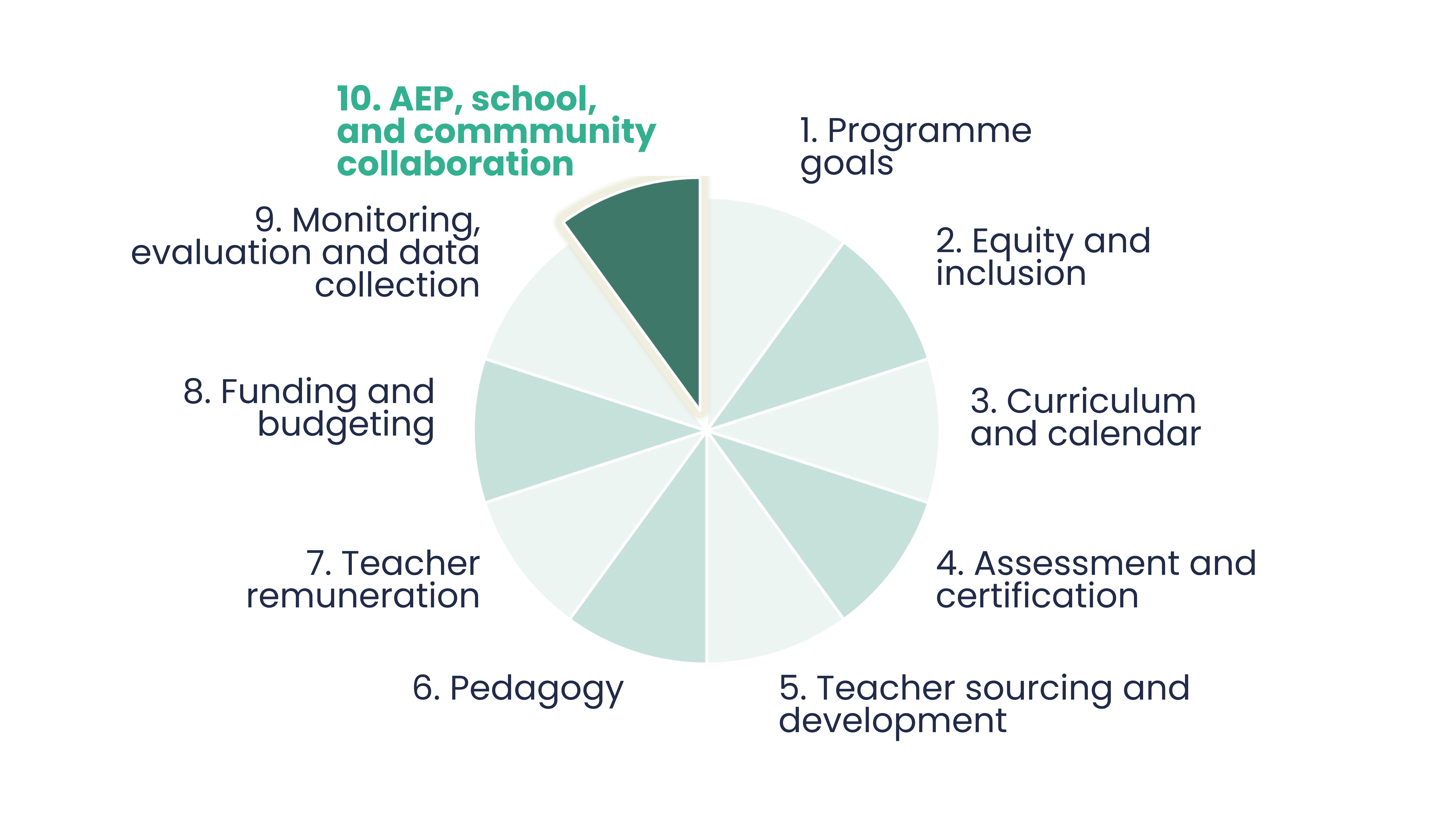
The missing link: 10 characteristics of effective AEPs
AEP implementation approaches look vastly different. Their curricula and rate of acceleration, target population, funding models, and degree of community engagement or cross-sector coordination vary substantially. 17 Some are hosted in schools, some are ‘linked’ to schools allocated to receive AEP graduates. Others operate separately from schools and the formal education system—delivering education to learners in hard-to-reach places in community learning centres, religious buildings, tents, or the homes of community members. Some operate in refugee camps or settlements. Some are implemented by the state, and others by NGOs. Even the same model can function very differently within a country, depending on the local context. So, what makes an AEP effective?
Building on the work of the Inter-Agency Network for Education in Emergency’s (INEE) Accelerated Education Working Group (AEWG), our first AEP synthesis (Grant-Lewis et al., 2022) highlighted the importance of government alignment in relation to nine characteristics of effective AEPs. Alignment is the degree to which an AEP is woven into a country’s existing education policies and legal frameworks, financing, data, and governance or accountability structures. It sits on a continuum: from informal coexistence to full system integration. It also shifts as needs change, policies evolve, financing streams open, and mutual responsibilities become clearer. Alignment is not a one-size-fits-all solution but takes many forms in different contexts. Local experiences point to the need for a strategic, phased approach to strengthening AEP alignment with national systems, based on their priorities and readiness. The nine key characteristics of alignment identified by our AEP synthesis (Grant-Lewis et al., 2022) include:
- Clear programme goals focused on OOSCY achieving fundamental competencies in an accelerated timeframe and on accessing future pathways of formal schooling, further training, or employment;
- A focus on equity and inclusion, removing barriers for marginalised learners;
- Curriculum competencies and calendar aligned to the formal education system, so that AEP learners develop key skills necessary to enter formal school, and final assessments are taken in-time to enrol in school (when AEPs are designed to support school re-entry);
- Assessment and completion mechanisms, including certification processes endorsed by the government, if certificates are used;
- Pedagogy that is learner-centred, culturally-relevant, and that draws on learners’ home languages and prior learning;
- Teacher sourcing and development (with a focus on community teachers);
- Providing teachers remuneration to sustain their wellbeing and
- Adequate funding and budgeting;
- Robust monitoring, evaluation, and data systems
- These are now joined by a 10th characteristic: AEP, school, and community collaboration which have proven fundamental not only to ensure OOSCY access and complete AEPs, but that they are also able to continue to learn and progress in the formal education system (see Image 1 below).
Image 1. The ten characteristics of effective AEPs
This Transitions synthesis thus completes the story, following the AEP learner on their transition journey, from the moment they re-enter school, to the completion of the grade level they transition to, and ultimately the full school education cycle. It introduces the Framework for Supporting Transitions through Evidence-Based Planning (STEP), or the STEP Framework, which provides a lens for education decision-makers to plan around the needs of the learner as they make their way from AEPs to formal school (see Image 2). Rather than seeing transitions as a single step, it recognises that transitions are a complex process. It breaks down the learner’s transition pathway into five clear stages, each with their own specific risks and evidence-based mitigation strategies. Underpinning these five stages is one cross-cutting foundational action: collaboration between AEPs, formal schools, and communities.
Image 2. The STEP Framework for Supporting Transitions through Evidence-based Planning
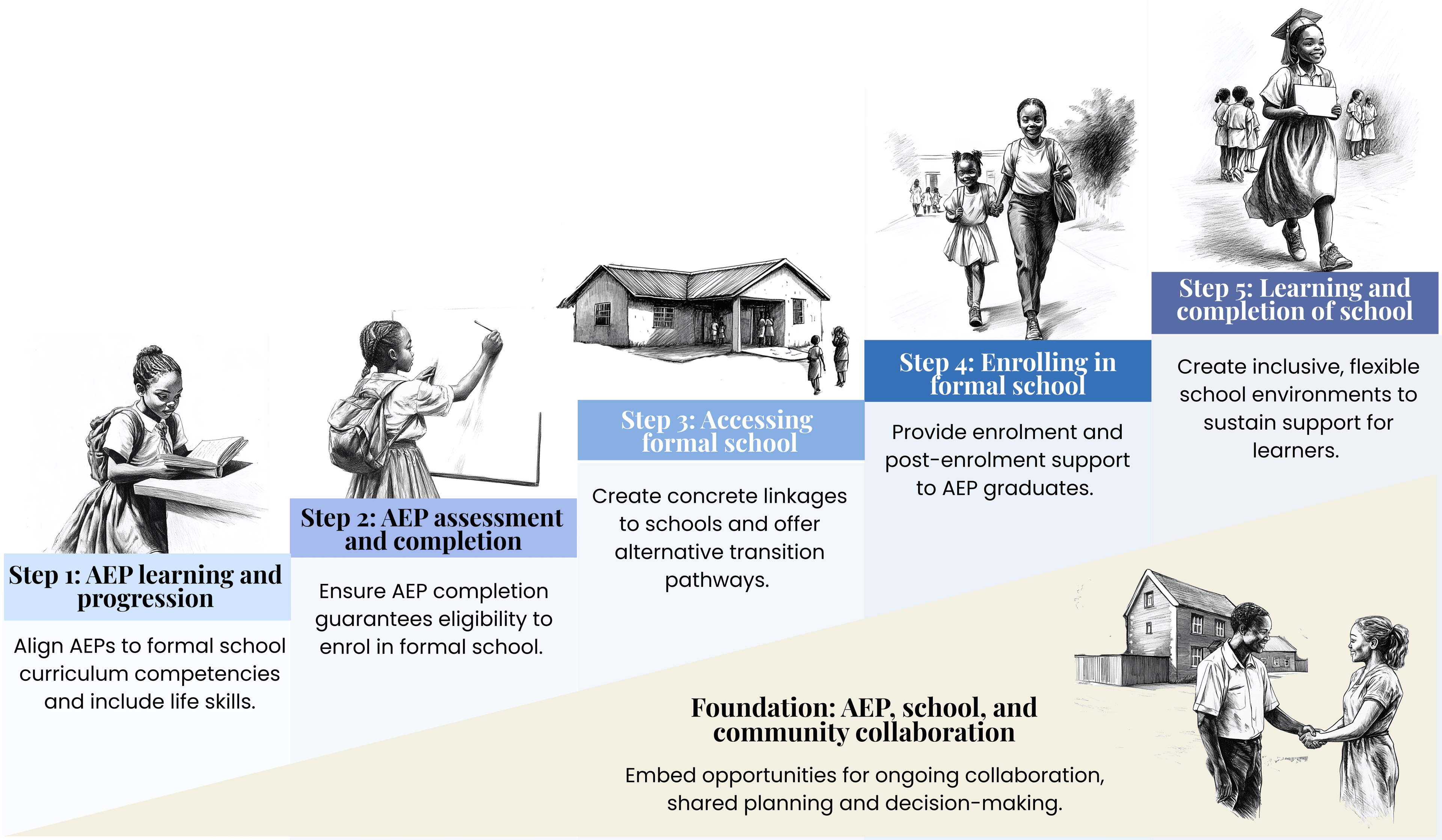
Collaboration amongst stakeholders is a key lever of success, regardless of the AEP model or context. Where the interaction between the AEP, formal school, community, and local government is strongest, and all actors within the AEP ecosystem are integrated and engage cohesively, conditions are more conducive to learning and to learners transitioning from AEPs to formal schools (e.g. Akyeampong et al., 2018; Humphreys et al., 2017). When these actors work together, transitions are smoother: expectations clearer and learners are better supported due to more efficient use of resources, shared accountability and improved continuity. Numerous studies, from diverse contexts, highlight how the participation of communities, in particular, contributes to scaling and sustaining the positive impacts of AEPs (e.g. Associates for Change, 2023; Valenza et al., 2021).
Collaboration amongst schools and communities helps ensure that equity isn't just a feature of the accelerated model, but that it remains a focus in every step of a learner's journey. Multisectoral collaboration and partnerships with community-based organisations or civil society help ensure learners basic needs are met, in nutrition, health, protection, water sanitation and hygiene (WASH), or menstrual health hygiene for girls (Pereznieto et al., 2017; Arvisais et al., 2021; Salem et al., 2023). When parents and caregivers are sensitised, learning environments—in AEP centres, schools, and households—are more protective and supportive (e.g. Bergamini et al., 2017). Meaningfully engaging with families, and local and cultural leaders has been essential to the inclusion of girls, young women, and learners with disabilities (Rose et al., 2023; Salem et al., 2023; Singal et al., 2022). Community participation also helps to ensure teaching and learning are relevant, connected to real-life experiences, and grounded in the social and cultural realities of learners, features that can inform policy and practice across formal and non-formal systems (Akyeampong & Higgins, 2025).
The principle of cohesion amongst education and community stakeholders extends beyond formal schools—it also applies to programmes transitioning learners to skills and vocational training or livelihoods opportunities. In these cases, linkages must be made to training institutes or employers, and multisectoral collaboration will continue to be critical for long-term success (Rose et al., 2023; Bell et al., 2018). Because of this, we have decided to add to our AEP (2022) synthesis a tenth characteristic of effective AEPs that leads to the long-term success of AEP graduates regardless of where they transition to: community collaboration.
While community collaboration is vital as a foundation to successful transitions, there are three additional characteristics of effective AEP’s which are worth highlighting as they can also directly impact outcomes across the transition pathway. The STEP Framework emphasises the importance of sustaining a focus on equity and inclusion, harmonising nonformal and formal education data systems, tracking different learner outcomes across the transition pathway, and ensuring funding and budgeting is allocated to activities that support transitions. While these cross-cutting issues will be explored more comprehensively in our forthcoming accompanying thematic briefs, we examine evidence specifically related to transitions in the following sections. These cross-cutting elements are then followed by a presentation of the STEP Framework, including its five insights and one foundational action.
Transitions for whom? Sustaining a focus on equity and inclusion
While designed to serve the most marginalised OOSCY, AEPs may contain features that unintentionally exclude the very learners they are intended to reach. Understanding these patterns is essential to ensure that programmes are both effective and equitable. The following considerations can help strengthen equity and inclusion for all AEP learners, especially during transitions.
Marginalisation is multidimensional. Learners face intersecting challenges shaped by poverty, gender, age, displacement, and disability. The strength of AEPs lies in their focus on equity, and their capability to address these intersecting barriers faced by learners. Children and young people benefit most when education is holistic and addresses not just their academic needs, but also their broader wellbeing (e.g. Akyeampong & Higgins, 2025). To preserve these gains, education leaders must sustain this equity focus through learners’ entire transition journey - particularly once they enter formal school, where support is often less flexible or personalised (Kebede, 2018; Valenza & Dreeson, 2022; Batezai & Kiazai, 2022). While sometimes this may require additional resources—often lacking in formal education systems—other times it is about more efficient use of existing resources (as explored in the following section on financing). This section explores various characteristics of marginalisation that affect AEP learners and their transitions to formal schools. While some strategies to support these learners are briefly discussed, they are elaborated in more detail when presenting the STEP Framework.
Socio-economic barriers were the most prominent in the evidence, leading learners to drop out of AEPs and schools, or to not enrol in formal school after completing a programme. Adolescents and youth from low-income households are more likely to have to work or support household activities so their parents can work, sacrificing schooling to meet more immediate needs (Seymour, 2016; Empatika & Stats for Development, 2023). Learners from low-income households, especially in rural areas, are also more at risk of not being able to pay for entry exams or school fees or access a formal school nearby (Martínez et al., 2024; CSEA, 2024; Baxter et al., 2022; Menendez et al., 2016). AEP learners can also be more exposed to bullying and mistreatment by peers and teachers in the schools they transition to, as they may be perceived as poorer or less educated (Graça Michel Trust, 2023; Seymour, 2016).
Effective transition support strategies—several of which will be explored in the following sections—address the direct and indirect costs of formal education and ensure the broader wellbeing of AEP learners. In contexts of extreme poverty, especially in humanitarian settings, integrating educational programmes with wider social protection, health, nutrition, psychosocial support, and WASH services, including menstrual health hygiene for girls, is critical to incentivise participation in school (Rose et al., 2023; Kebede, 2018; Pereznieto et al., 2017).
Girls and boys face unique barriers rooted in harmful gender norms. These barriers are particularly pronounced for older adolescents. While girls and young women may be pulled out of school or AEPs because of early marriage, pregnancy, or gender-based violence, boys and young men are often expected to work and support their family’s income (e.g. Oddy, 2019; Empatika & Stats for Development, 2023; Graça Machel Trust, 2023). These risks intensify in contexts of extreme poverty, conflict, displacement, or disaster (Salem et al., 2023; Oddy, 2019; Pereznieto et al., 2017).
Changes in gender norms are possible, however, and are more likely to be sustained through community mobilisation, meaningful participation of religious and cultural leaders, and multi-sector collaboration, including engaging not just women and girls, but also men and boys (Rose et al., 2023; GEC, 2024/2025). Creating safe and protective, gender-responsive learning environments—such as girls’ only WASH facilities, hygiene kits, life skills education or training teachers in gender-responsive instruction and to address instances of gender-based violence—can reduce stigma and improve access and learning (Rose et al., 2023; Salem et al., 2023). In Afghanistan, for example, the GEC-funded STAGES project distributed menstrual hygiene kits to all female AEP learners, contributing to gender parity in attendance and completion (GEC, 2021). While targeted support strategies for boys are less commonly found in the evidence, a key barrier to boys’ access and retention is their need to work to earn money for their families (e.g. Ghana: Casely-Hayford et al., 2022; Uganda: Oddy, 2018). Reducing the amount of work that both boys and girls need to do to contribute towards their households’ income, is a common issue discussed in the following sections.
Age intersects with gender, compounding risks for adolescents, youth, and overage learners. In adolescence, gender norms often intensify and family expectations around marriage or motherhood for girls become more pronounced (Rose et al., 2023). Overage students often face ridicule and bullying when placed in classes with their younger peers (Kyeyune et al., 2023; Menendez, 2021; Seymour, 2016). This discourages their participation in formal education (Chávez et al., 2020), with some older learners preferring to transition to technical and vocational training or work (da Silva et al., 2022; GEC & UKAID, 2023). For older learners who work, the lack of flexibility in school timetables may push them back out of the formal system (Graça Michel Trust, 2023).
Older learners are also more at risk of facing policy-related barriers, such as age restrictions that hinder formal school enrolment or access to entry exams (West Africa: Runchel et al., 2023; Bangladesh: Valenza et al., 2021; Mexico: Williams, 2021). Various studies found that older students are also more likely to drop out of formal school after transitioning (Tanzania: Graça Michel Trust, 2023; Nepal: Bhatt & Shreshta, 2022b; Liberia: Menendez, 2021; Ethiopia: Akyeampong et al., 2018; West Africa: Kebede, 2018; Colombia: Betancourt, 2017). At the secondary level, where school infrastructure is more limited and curricula more demanding, learners (and teachers) often require additional support (GEC, 2021). Yet very few programmes are designed to consider the specific needs of youth and adolescents, including by offering alternative transition pathways to skills and vocational training or work (Sommers & Nasrallah, 2024; IDRC, 2024). These issues are explored in more detail particularly in Insight 3 and Insight 4 of the STEP Framework.
Learners with disabilities face environmental, attitudinal, and policy-related barriers. In many contexts, school infrastructure and learning materials remain inaccessible, and a lack of trained professionals hamper progress, both in AEPs and especially once in the formal education system (Singal et al., 2023; Baluch, 2023). Some AEP implementers have struggled to identify learners with disabilities, due to stigma or parents who ‘hide’ their children in fear of discrimination (Baluch, 2023). While various AEP providers have successfully mobilised, screened, and assessed learners with disabilities using internationally recognised tools like the Washington Group Questions, this requires substantial training for enumerators to ensure data quality (Bangladesh: FCDO, 2023).
Partnerships with organisations of persons with disabilities (OPDs) and addressing stigma within communities and schools is essential to ensure parental and community support for learners’ with disabilities right to education (Singal et al., 2023; Diané et al., 2022). Additional strategies that have proved promising include: collaborating with Special Education departments, integrating inclusive education in pre- or in-service teacher training (Nigeria: CSEA, 2024; Uganda: GEC et al., 2024), training and sensitising school management committees and communities (Uganda: Baluch, 2023), linking learners with disabilities to social protection schemes (Ghana: GEC, 2022) or providing learners with assistive devices, Individualised Education Plans, specialised services such as physiotherapy or mental health and psychosocial support (MHPSS), and reasonable accommodations in instruction and when taking assessments 18 (Malawi: Singal et al., 2023; GEC, 2024; Uganda: Baluch, 2023).
Forcibly displaced learners experience unique challenges. AEPs in refugee contexts are sometimes disconnected from national systems, offering few options for learners to transition (e.g. Ramakrishnan, 2022), and often reflecting larger policy challenges related to the inclusion of refugees in national systems (e.g. Henderson & Hough, 2025). 19 Displaced learners often lack identity documents, or previous school records, making school enrolment and the validation of their qualifications difficult (Nasrallah, 2022; Restrepo-Saenz & Agudelo-Navarro, 2022; Williams, 2021; Menéndez et al., 2016; Bhatt & Shreshta, 2022a/b).
Enhancing access, by procuring necessary documentation for learners to enrol in school, advocating with local authorities to overcome administrative hurdles to enrolment is essential (Bhatt & Shreshta, 2022a/b; Valenza, 2018). Mobility also disrupts learning, as some learners and their families deprioritise formal education due to uncertainty and plans to return home or continue their migration journey (e.g. Kenya Dadaab Refugee Camp: Flemming, 2017; Afghanistan: Shah, 2017; Mexico: Williams, 2021). In Somalia, mobile libraries, and Temporary Learning Spaces (TLS) established along migration routes, enabled IDP families to choose travel routes that facilitated the continuation of their children’s education (Nicolls et al., 2021).
In refugee camps and settlements, safety continues to be a major concern in and around schools (e.g, Kenya: Arvisais et al., 2023). Ensuring the protection and broader wellbeing of displaced learners who have likely experienced trauma or instability is critical. This can be done by integrating education with child protection, mental health and nutrition, hiring refugee teachers with similar cultural backgrounds and experiences to foster positive relationships, and embedding play and constructive classroom management strategies into daily practices (Valenza, 2018; Shephard et al., 2023; see also our Kenya case study).
Ethnic and linguistic minority groups often develop foundational skills at a slower rate than their peers (Nigeria: Diazgranados Ferráns et al., 2022; Pakistan: Glow Consultants Ltd, 2022; GEC & IRC, 2024), with several sources mentioning lower completion (Bangladesh: FCDO, 2023) or transition rates (Glow Consultants Ltd, 2022l Nepal: Chávez, 2020). Nomadic and pastoralist communities, in particular, often have lower attendance rates or are more likely to drop out due to seasonal migration (Pakistan: PAGE, 2023; Uganda: Sekaggya-Bagarukayo and Oddy, 2022). Flexible timetables and mobile classrooms have successfully expanded access to pastoralist communities (Somalia: Nicolls et al., 2021). Girls and young women from certain communities are more likely to be restricted by social norms that dictate expectations around acceptable roles (Rose et al., 2023). In Latin America, indigenous and Afro-descendant populations must also be considered, albeit the lack of evidence on these learner populations (Colombia: Restrepo-Saenz &. Agudelo-Navarro, 2022; Panama: UNICEF Panama, 2022).
Overall, there are limited programmes that provide targeted strategies to support ethnic and linguistic minority groups, as confirmed by previous syntheses (e.g. Ramakrishnan, 2022). Those transition strategies emerging from the evidence include engaging families and caregivers, providing language support in the form of tutoring or additional materials, recruiting and training teachers from local communities (Kenya: Ngindiru et al., 2022; Ghana: Montrose International, 2022), and promoting social cohesion in AEPs and schools, especially in contexts of conflict and displacement (Kenya: Arvisais et al., 2021; Liberia: Menendez et al., 2021); Uganda: Oddy, 2019. In multilingual settings, it is important to ensure SEL, and the broader curriculum are culturally relevant, and that AEP facilitators have the language skills and confidence to deliver this curriculum effectively; otherwise, AEPs may reinforce existing inequalities between ethnic groups (Nigeria: Diazgranados et al., 2022).
To sustain gains made through AEPs, the root causes of inequality within education systems and societies must be a core focus of policy or programmatic interventions. Addressing the needs of all learners requires a tailored approach, informed by regular analysis of intersectional data and community participation. Only then can policies and programmes meet learners where they are—and ensure no one is left behind.
Financing and costing transitions: a gap in the evidence
Robust costing data remains a major gap in the evidence. In total, 43 of the 151 sources selected for deeper analysis (29%) provide some sort of data on costs, with many claiming that AEPs offer a good value for money. 20 However, the quality or robustness of the evidence is often questionable, based on estimates or providing limited details on how costs or results are measured. More transparent reporting by donors and implementers is needed to enable meaningful cost-benefit and cost-effectiveness analyses. Without this, it is difficult to make a strong investment case for AEPs and post-AEP transition support to governments or funders.
The issue of sustainable financing is a prominent challenge noted in the evidence, across various implementation and funding models. Numerous studies point out that non-formal education in general is under-funded (even more so than formal education systems) (e.g. CSEA & IDRC, 2024) highlighting the need to embed AEPs and transition support strategies into government or donor financing mechanisms and budgets. The lack of sustainable financing is particularly a challenge for AEPs serving refugees or in crisis-affected settings, where programmes often depend on short-term humanitarian funding, underscoring the need for greater cohesion between humanitarian and development funding models (e.g. Bergamini et al., 2018). 21 Indeed, seeing AEPs as a short-term solution or temporary response to crisis often contributes to programmes not collecting data on transitions to formal school or other outcomes post-completion (e.g. Shah, 2017). To increase the long-term financial stability for AEPs, studies have emphasised the importance of pooling diverse funding resources across governments, NGOs, and donors (e.g. Associates for Change, 2023). While NGOs can help mobilise resources, donor dependency jeopardises the sustainability of AEPs (ibid). Where AEPs are almost entirely funded and delivered by non-state actors, the transition to formal schooling presents a high-risk period where accountability to learners often shifts from AEP providers to the government. Because donor-funded projects often fall within a limited timeframe, several studies have noted the need to embed ‘handover plans’ or ‘exit strategies’ into the initial design of these programmes, to ensure support for learners is sustained (Malawi: GEC & UKAID, 2023; da Silva et al., 2022; Mali: Bell et al., 2018).
The evidence also suggests the need to make better use of existing resources within education systems. Research on AEPs often point to how they are cost-effective approaches to addressing the needs of marginalised learners (e.g. Ghana: Associates for Change, 2023; Liberia: Menendez et al., 2021; West Africa: Kebede et al., 2018; DRC: Valenza, 2018; Niger: Keilland et al., 2024). By employing innovative teaching methods, flexible curriculum delivery, and more comprehensive strategies for community engagement and coordination across sectors, AEPs often reduce the cost per student while maintaining educational quality (e.g. Niger: CSEA, 2024; Ghana: Associates for Change & IDRC, 2021). In Ghana, for example, researchers suggest that the government should adopt and scale the CBE model, as it can promote more efficient use of educational resources (Associates for Change and IDRC, 2021). Likewise, a donor from Pakistan described how financing isn’t only about money, it’s about drawing on existing resources and infrastructure more effectively. 22
Although post-transition supports add costs, if they raise transition rates they can reduce the cost per learner who successfully transitions. Only three studies provide costing data related to AEP learners once in formal schools. The GEC-funded STAGE project in Ghana, for example, had a higher financial demand than other CBE projects, in part due to the costs associated with post-transition support, such as bicycle banks and transition kits. These additional costs were deemed justifiable, however, and the support was regarded as cost-effective, since it proved essential to prevent dropouts and ensure the long-term success of girls in formal schools (GEC & UKAID, 2022). A second source—drawing on evidence from Ghana’s CBE—shows how the cost per transitioner is more than the cost per learner enrolled (Associates for Change & IDRC, 2021). This is unsurprising since not all learners who enrol, successfully transition. In practice, spending more per learner on transition supports (first source) can help raise transition rates; when transition rates rise, the cost per transition tends to fall (second source). Indeed, an independent evaluation of the GEC-funded Leave No Girl Behind programme found that across three implementing countries (Ethiopia, Malawi, and Nepal), transition rates were observed to be highest in Nepal, where programme implementers invested more in transition support strategies (Colquhoun et al. 2024).
Improved transitions also increase the value of money for programmes, as retention in school is likely to have long-term returns, including increased productivity and economic gains. The same GEC independent evaluation mentioned above found that after gains in learning, helping girls rejoin formal school was identified as the next most valuable outcome, both by the girls themselves and through quantified estimates (Colquhoun et al. 2024). The value of this outcome is closely linked to how many girls transition and how long they remain in formal education, since each additional year of schooling brings measurable long-term benefits. Projects in Nepal and Ethiopia demonstrated particularly high value, due to stronger transition rates into formal school. While it is still too early to know how long girls will stay enrolled, sustained transitions would significantly increase the AEP’s overall impact.
Rather than funding AEP implementation alone, budgets should be allocated to support learners as they transition into the formal system. The STEP Framework introduced by this synthesis can support AEP funders in planning longer term education solutions that are more likely to sustain outcomes for learners. While more research is needed on costing and sustainable financing, our synthesis revealed cost-effective approaches to support learners long-term in the formal education system (and beyond). Two strong examples include: pairing AEP interventions with income-generating activities and saving schemes (e.g. Akyeampong et al., 2018) or creating peer groups that build girls’ sense of belonging and participation in class and in their communities (e.g. GEC, 2021). These strategies are explored in the following sections in relation to Insight 5 of the STEP Framework.
Tracking transitions and long-term outcomes: what does it take?
This synthesis has revealed the vital importance of tracking both student- and school-level information to ensure learners can successfully transition and thrive long-term. At the student level, effective monitoring systems track not only AEP enrolment and attendance data, but also learner profiles (age, cohort, progression), learning outcomes, and, crucially, transition rates (Dalan Development Consultants, 2023; see our Liberia case study). This data should include when and where learners transitioned, and whether they complete their first year in school or continue to progress in school in the long-term. The same applies to AEPs offering alternative transition pathways, as monitoring systems must consider not only placement of learners into training institutions and jobs, but also their success within them.
Yet this level of detail is rare. Of 188 programmes reviewed in our programme map, we found transition data for just over a third (68 or 36%). 23 Moreover, how ‘transition’ is defined and measured varies greatly, from completion and eligibility to enrol, to intentions to enrol, or actual enrolment. At a minimum this synthesis suggests a common definition for conceptualising and measuring transition rates: ensuring learners complete their first year of formal schooling.
Tracer studies, or longitudinal studies that track learners as they progress within the system, offer a more comprehensive view of the long-term success of AEPs. To truly understand whether AEP impacts are sustained, data should capture where AEP graduates end up one or more years after they complete a programme (GEC & TetraTech, 2024). For example, one of the longest tracer studies, by Akyeampong et al. (2018), highlighted above, tracked Speed School graduates in Ethiopia six years post-transition and found improved attendance, retention, learning, as well as household livelihood outcomes. Another five-year tracer study following AEP graduates in Borno State, Nigeria found that while 72% of learners completed junior secondary school after AEPs, only 38% advanced to senior secondary (Associates for Change, 2022).
These studies help to understand returns of investing in AEPs. They also help identify bottlenecks and high-risk stages, so that education leaders can prioritise actions and the allocation of resources. Yet only 10 of the 151 studies selected for deeper analysis (a mere 7%) provide this longitudinal data. This evidence gap was also revealed in our AEP programmatic map, where only 9% of the 188 programmes reviewed had longitudinal studies. Where feasible, longitudinal evaluations should be embedded into programme designs, as they generate critical insights into how education and inequality shape the transitions of marginalised learners, not just to formal school but also as they progress from childhood to adolescence, and into adulthood (Griffiths et al., 2025).
At the school level, data systems should monitor readiness to absorb AEP graduates, including data on infrastructure, teacher qualifications, school feeding, remedial support, inclusive education accommodations, and psychosocial services (discussed more in Insight 3). In Tanzania, school-level data revealed that COBET classes were significantly impacted by the lack of teachers and school resources, with some class sizes reaching over 100 students per teacher (The Graça Michel Trust, 2023). In Sierra Leone, the Ministry’s AEP guidelines recommend drawing on national data sources like the Annual School Census and conducting mappings at the district level to identify and offer realistic transition pathways (MBSSE, 2024). In fragile settings, regular school monitoring is especially critical, as facilities may be repurposed or suddenly cease to function due to conflict or instability (Mali: Bell et al., 2018). School level data can be used to inform the allocation of resources, for example, through school capitation grants or to incentivize schools to absorb AEP graduates, but this requires harmonising data systems and ensuring all AEP learners are accounted for in countries’ education management information systems (EMIS) (The Graçha Michel Trust, 2023).
Integrating AEP learner data into EMIS enables continuous tracking across non-formal and formal systems. While some EMIS currently track enrolment and participation in accelerated education, our review of ESPs and annual Ministerial statistics reports found no evidence of government data tracking the longer-term learning or participation outcomes of these AEP graduates once in formal school. It is likely that capacity and resource constraints hinder progress. In West Africa, for example, local authorities considered the robust data systems used by Speed Schools as valuable, but unrealistic given time and resource constraints faced by the formal system (Kebede, 2018). Several studies pointed to challenges of accessing and collecting data from rural, remote, or fragile contexts, including high costs of transportation or security challenges (Diazgranados et al., 2022; Bell et al., 2018). The use of technology, such as artificial intelligence for assessment or low-cost apps to record and analyse data, may offer a cost-effective way to enhance data systems, and this may require collaboration between tech innovators and grassroots organisations (Bilqees, 2024).
Support from development partners can help bridge data gaps. In Somalia, ABE programme data was integrated into EMIS in 2022 as part of the USAID Bar Ama Baro initiative (Farah, 2024). In Pakistan, the GEC TEACH project helped integrate a database of trained female mentors into the EMIS to support long-term planning (GEC et al., 2024). With funding from JICA, the government of Pakistan has also developed a robust non-formal education management system (NFEMIS) that captures key performance indicators related to non-formal education facilities, teachers, and learners. 24 However, there is still a need to better integrate the NEMIS with the formal system EMIS (see our forthcoming Pakistan case study for more). 25 Similar efforts have been found in Tanzania, South Sudan, and Jordan, though more research is needed to assess sustainability and impact. Promising examples have also shown how formal systems adopt tools from AEP implementers, as explored in Insight 5 on school retention.
Introducing The STEP Framework: Six insights to facilitate successful transitions
The following sections examine the evidence across six insights: one for each of the five stages of the STEP Framework and a sixth for the foundational action on collaboration between AEPs, formal schools and communities. The insights and their associated evidence-based actions are not only relevant to AEPs—they offer important considerations for facilitating learners’ transitions from other non-formal education models, as well as within the education system, from one grade to the next, or one school to another. The framework can also be adapted for AEPs that offer alternative transition pathways, such as to skills and vocational training or employment (see Insight 3 in particular). By adhering to LIFTED’s user-centred approach, we emphasise strategies and solutions whenever feasible. However, clear evidence gaps exist (while these are explored throughout the following sections and reiterated in our call for further research in the conclusion, see our technical report for an evidence gap map).
For many countries, stages of the STEP Framework, and groups of marginalised learners, the evidence revealed more risks and challenges than effective responses. While more evidence is needed to understand how to best overcome these challenges, understanding barriers to exclusion are an important first step towards fostering inclusion in formal education systems. As ex-Minister of Education, and current Chief Minister of Sierra Leone, David Moinina Sengeh writes, ‘The problem is that we can’t fix a problem until we know its scope’ (Sengeh, 2023). The STEP Framework does just this, mapping the enabling conditions for action, and—where impactful interventions are limited—surfacing barriers and risks that marginalised learners encounter on their journeys from AEPs to formal schools. Indeed, as a donor mentioned, ‘programmes can often underestimate barriers.’ Therefore, where there is a lack of evidence, we call attention to these challenges to illuminate the complexity of transition pathways, and better support education leader to map relevant risks to their contexts.
Each of the following sections includes a summary of the supporting evidence, the strength of the evidence-base, and key associated actions for education actors. By ‘strength’ of the evidence, we refer to both the quantity and quality of evidence selected for deeper analysis, using our LIFTED approach. Quality considers both relevance to the research question, geographical contexts (LMICs and crisis-affected countries), the inclusion of under-represented voices or perspectives (including not only learners but also local researchers and practitioners), as well as whether the evidence provides solutions grounded in research or implementation by governments, providers and communities documented in programme and policy sources. The summary boxes seek to outline the most relevant findings for the STEP Framework and successful transitions to formal schooling. For more specific guidance, including actions tailored to stakeholder groups, including governments, implementers, and donors, see our accompanying high-level guidance. In the sections that follow, the term ‘AEP learners’ is used to refer to all participants of AEPs, while ‘AEP graduates’ refers to those learners who have been able to pass the final AEP assessment and complete the programme (with or without a certificate, depending on context).
Insight 1. Align AEPs to formal school curriculum competencies and include life skills.
Supporting evidence:
| Key actions:
|
Strength of evidence: This STEP has the most robust evidence, spanning 123 sources selected for deeper analysis, with 36 programme evaluations and 17 impact studies, many of which compare outcomes of AEP learners with their peers in formal school. There were 26 peer-reviewed studies. Some of the strongest evidence sources showed the importance of FLN, SEL, home language of instruction, learner-centred pedagogies, and community teachers. Many also provide data on issues of equity and inclusion in teaching and learning, especially those relevant to girls and crisis-affected learners. Several programme evaluations and some peer-reviewed studies also provide rich data drawing on a wide range of stakeholder perspectives, especially the voices of girls and refugees. More research is needed to better understand the trade-offs of incorporating broader curricular subjects and formal school language of instruction into AEP curricula in an accelerated timeframe. | |
Building on AEWG’s (2017) ten principles for effective practice, our AEP synthesis (Grant-Lewis et al., 2022) 26 highlighted how effective AEPs consist of age-appropriate curricula, aligned with national qualifications, and designed to nurture foundational skills through learner-centred teaching, 27 mobilisation of community teachers, and the use of home language of instruction. Many of these factors—especially the importance of building learner’s foundational literacy and numeracy skills or the effectiveness of learner-centred pedagogies, and approaches such as Teaching at the Right Level (TaRL) or structured pedagogy, are well supported by evidence emerging from both non-formal and formal education settings (see, our Liberia case study for more, and Akyeampong et al., 2023 and UNESCO et al., 2022 for examples from formal education systems). The importance of closely supporting teachers, through training, coaching, or mentorship that focuses on classroom practices and aligns to their needs is also well documented in the evidence (see our Speed School case study for more on this). This requires equipping teachers (and learners) with quality teaching and learning materials beyond the textbook, including low-cost resources and those from the natural environment (e.g. Akyeampong et al., 2016).
Insight 1 of the STEP Framework focuses on the alignment of AEP and formal school curriculum in relation to core competencies and the language of instruction so that learners are prepared to enter formal school. This process of alignment includes mapping key formal school curriculum competencies and knowledge that will prepare learners for formal school, while also engaging communities in curriculum development, to ensure content is relevant to the lives, experiences, and needs of learners. 28 Indeed, the process of curricular alignment should not be one-directional: formal education systems can also learn from AEPs in their design of national curricula, for example, by drawing on creative approaches to leverage local values, linguistic and cultural identities, or cultural artefacts such as songs and storytelling (Akyeampong & Higgins, 2025). By valuing learners’ firsthand experiences, fostering teacher agency, and engaging communities, this ultimately contributes to more authentic, and impactful, learning experiences and student-teacher interactions (Ibid). We address this more in Insight 5 on formal school learning environments.
Foundational literacy and numeracy (FLN) prepare learners for formal schooling, but low-performing AEP graduates, especially girls, continue to struggle once in formal school. This makes formative assessment a critical tool for providing targeted support for learners or understanding when they should be promoted to the next level. 29 Ensuring FLN skills prepare learners for formal school requires working closely with government actors, to develop AEP curriculum aligned with the skills and competencies of the formal school curriculum (e.g. da Silva et al., 2022). Various studies have shown that learners with better FLN skills survive longer in formal schools (Ethiopia: Akyeampong et al., 2018; Uganda: Kyeyune et al., 2023). However, research from Ghana suggests that learners—especially girls—who perform below their peers in FLN subjects during an AEP, continue to under-perform compared to their peers once in formal school (Akyeampong et al., 2018; Carter et al., 2020). The use of formative assessment helps teachers to continuously monitor learners’ FLN skills and adapt instruction as needed (e.g. UNICEF Panama, 2022). In Punjab Pakistan, efforts to strengthen formative assessment include a customised digital application that enables monthly learner assessments and provides teachers with real-time data (AAN Associates & UNICEF, 2022) (see also our Liberia case study).
Life skills, though increasingly a part of accelerated education curricula, is not always included and is often deprioritised in favour of tested subjects, in a similar way to the formal system. Whether referred to as life skills, social-emotional learning (SEL), soft skills, 21st century skills, or bundled in sexual and reproductive health education curriculum, over a third (36%) of all sources selected for deeper analysis reported on these outcomes. From this, we see a consistent pattern across the evidence base which highlights just how pivotal life skills and SEL are for marginalised learners, who are often navigating the steepest hurdles, not just academically, but in other aspect of their life (e.g. Senegal: Contreras Gomez, 2024; El Salvador: Hernández González, 2020; Ethiopia: Akyeampong et al., 2018). Yet not all programmes include these skills, due to the need to focus on preparing learners for exams that are required to transition back to formal school, and that often narrowly focus on literacy and numeracy (AEWG, 2020). 30 For example, a review of impact evaluations of the International Rescue Committees’ VYF programme in DRC found that a heavy focus on high-stakes exams led to teachers teaching-to-the test and not providing enough time to teach other social-emotional and cognitive skills (Valenza, 2018). 31
When backed by culturally relevant materials and teacher training, and monitored closely, life skills curricula can contribute to the long-term success of learners in schools. AEP graduates entering formal school often face unfamiliar teaching methods, larger class sizes, and peer dynamics that can be difficult to navigate. Various studies suggest life skills make learners more resilient and prepare them to overcome these challenges by developing their self-confidence, motivation, communication, and more. For example:
- In Senegal, learners with more confidence and conflict resolution skills were more likely than their peers to transition to formal schools, even when taking into account academic achievement (Contreras Gomez Rafael, 2024).
- Girls with higher self-efficacy scores in Zimbabwe’s SAGE programme were over 10% more likely to transition successfully (Melville et al., 2023).
- AEP graduates from Ethiopia’s Speed School developed more confidence in their ability to learn, allowing them to thrive in formal school classrooms, despite the use of more didactic instruction (Akyeampong et al., 2018).
- Curricula in sexual and reproductive health and children’s rights led girls to have improved literacy and numeracy outcomes in Pakistan (GEC et al., 2024) and Nepal (Bhatt and Shreshta, 2022a).
Life skills, especially SEL, are particularly important in contexts of conflict, disaster, or displacement, where children (and teachers) often face trauma or adverse experiences. In these contexts, classroom-based SEL curricula can be integrated with broader psychosocial support services (Valenza, 2018; see also our Kenya case study for more). Importantly, when teachers’ wellbeing is prioritised, SEL efforts are more likely to achieve positive outcomes for learners (see our Colombia case study). If teachers are not adequately supported, SEL curricula may not lead to improvements in SEL outcomes for students (as found in Nigeria: Diazgranados et al., 2022).
While learners learn best in a home language of instruction, it is important they also have exposure to the formal school language of instruction before transitioning. In AEPs, learners’ home languages and phonics-based teaching are often used to facilitate the development of foundational skills (e.g. McManus et al., 2024; Poli et al., 2022; Griffiths et al., 2025), while enhancing community engagement and participation (e.g. Akyeampong & Higgins, 2025). Transitions to formal schools mean starting to learn in new languages, such as English or French. Some evidence, especially from Ghana, suggests that learners have strategically used their language skills to translate content into their home language to aid comprehension (Akyeampong et al., 2018). While this is promising, this is not the case everywhere. For many learners, formal school language of instruction continues to be a major barrier and source of frustration, hindering the success of AEP learners once in formal schools (Ghana: Carter et al., 2020, van de Waal et al., 2024, Abreh & Wilmot, 2018; Sierra Leone: Ofori Owusu et al., 2023; Turkey: Sunata & Abdulla, 2020; Uganda: Kiiria et al., 2024; West Africa: Runchel et al., 2023). 32 Oftentimes, this causes learners to regress in their learning or drop out of school (e.g. Ghana: Carter et al., 2023; Lebanon: Bergamini et al., 2017). To better prepare graduates, some AEPs, such as the SSA/P Gateway in West Africa, gradually transition learners from local languages to formal school languages over time, helping them build both fluency and confidence. 33 Others provide bilingual literacy materials and dictionaries to aid learning (e.g. Madagascar: Valenza et al., 2021). At the system level, some countries—such as Mauritania—have passed laws requiring all primary school classes to be taught in local languages (The World Bank, 2023).
Exposure to broader curricular subjects is desired by AEP learners, and also better prepares them for transitions to formal school, especially at the secondary level. A narrow focus on literacy and numeracy may not suffice, if learners and their families feel core subjects of the formal school curriculum are excluded (Malawi: da Silva et al., 2022). This is particularly relevant at the secondary level, where AEP graduates often re-enter the formal education system having high-stakes exams in subjects such as science or social studies. AEP learners from Nigeria, Ghana, and Colombia express a desire for these subjects and others, such as ethics, technology, music or physical education, and often enter the formal school system excited to learn new subjects (CSEA & IDRC, 2023; Akyeampong et al., 2018; Romero, 2017). Some government-led efforts—such as Nigeria’s Accelerated Basic Education Programme (ABEP)—have seamlessly integrated broader curricular subjects into national accelerated education guidelines and curricula, supporting learners’ transitions to formal education (see our case study for more). 34
In other contexts, time constraints have limited what subjects can be covered (Global: Menendez et al., 2016; Guinea Bissau: Conestà, 2020). Indeed, while the rate of compression for accelerated education programs is most commonly two years of curriculum condensed into one year, there is great variation (USAID, 2020). For example, School for Life in Ghana condenses three years of the formal curriculum into only nine months, while the Ability-Based Accelerated Learning (ABAL) project in Bangladesh lasts up to 44 months 35 (USAID, 2020; Valenza & Dreesen, 2022). We found limited evidence on how best to sequence or combine subject knowledge within short programme cycles. More research is needed to inform curriculum and delivery models that are both feasible and effective for preparing learners to succeed in formal schools and beyond.
Insight 2. Ensure AEP completion guarantees eligibility to enrol in formal school
Supporting evidence:
| Key actions:
|
Strength of evidence: A total of 43 sources of evidence provide evidence on Insight 2, including 12 programme evaluations. Four impact studies either provide completion or graduation rates, or stakeholder perspectives on challenges with completion exams and transition pathways. While many sources emphasise the importance of accredited transition pathways, and challenges related to these, few robustly examine or compare the effectiveness of the different pathways available to learners. Indeed, most of the evidence concentrates on challenges related to the lack of flexibility in certain pathways offered, or barriers in accessing exit exams and the placement tests that follow. These are complemented by policy documents and practitioner consultations that demonstrate efforts to create more flexible transition pathways or accreditation systems. One peer-reviewed study examines the validity of placement tests, while policy and programmatic documents present small-scale solutions, though more robust evidence is needed to measure their impact and scale, as well as issues of equity, such as those faced by girls, ethnic minority learners, refugees, or learners with disabilities. | |
Education.org’s AEP synthesis (Grant-Lewis et al., 2022) highlighted the critical importance of government endorsement of AEPs and their accreditation of AEP learner skills and qualifications. 36 When AEP competencies are formally recognised by Ministries of Education, learners are better positioned to continue into the formal system or other accredited transition pathways. Evidence points to the critical importance of designing AEP completion exams and transition pathways together with governments, especially local authorities (e.g. Diazgranados et al., 2022). In Pakistan, for example, the Federal Ministry has created an equivalency framework that has enabled provincial governments to create assessment and certification systems that align with national standards (AAN Associates & UNICEF, 2022). 37 Encouragingly, an increasing number of AEPs are now certified by government authorities—a promising sign of system-level integration (Ramakarishnan, 2022). In some cases, learners receive government-endorsed completion certifications to recognise their skills. 38 Sometimes, this requires sitting for a national exam administered by the government. 39 In other cases, a Memorandum of Understanding (MoU) between the government and AEP provider is enough to recognise AEP learners’ skills, allowing them to transition into the formal system. 40
However, in many contexts, this recognition remains absent. Analysis from our programme map, with data validated by donors, found that out of 170 active AEPs at least a quarter (29%) did not provide learners with a government-endorsed completion pathway. 41 These programmes were mostly from the Sahel region of sub-Saharan Africa (e.g. Burkina Faso, Niger, Mali), as well as parts of South Asia (Bangladesh, Afghanistan) and the Middle East (Lebanon). Without government support, these programmes struggle to offer learners a route into the formal system. While it is the responsibility of governments to make sure clear processes are in place for programmes to formerly register for accreditation, in the absence of such processes, non-government actors can advocate for, and invest in, closer alignment.
The quality and accessibility of completion exams and the insufficient flexibility of transition pathways are often a concern. For example, the use of challenging, high-stakes, summative exams in the Philippine's Alternative Learning System (ALS) has resulted in low transition rates (Ramakrishnan, 2022). In South Sudan, the absence of standardised assessments has led to highly variable testing practices, with individual teachers, schools, or districts responsible for designing exams, often with limited support (Nicholson, 2018). While Ethiopia’s Education Sector Plan articulates plans to standardise frameworks for assessment and certification in AEPs (Federal Ministry of Education, 2021), implementers note that this standardisation is still lacking, a sentiment echoed in interviews with AEP implementers in Uganda and Kenya. In Kenya, secondary-level certification rules require a four-year gap between completing primary school and registering for the national secondary exam, creating a bottleneck for overage learners in AEPs who complete their programme in less time (Boisvert, 2017a). Despite being ready to advance, learners may be forced to delay their education or remain in an AEP longer than necessary to meet an administrative requirement (Ibid).
In other contexts, there is limited flexibility in the transition pathway available to learners, with certification of completion only being provided after certain levels of the AEP (Mali: Bell et al., 2018; DRC: Valenza, 2018). In these cases, the lack of flexibility is often due to AEPs depending on the timing or regulations of Ministerial high-stakes exams, emphasising the importance of adapting not just AEP assessment practices, but also those of formal school systems. A promising example is found in the 44-month long ABAL programme in Bangladesh, where learners can transition to formal school at any point, or choose to finish the full programme and take the end-of-primary cycle examination (Valenza et al., 2021). 42
Completion benchmarks and pathways must be accessible, feasible, and flexible to ensure transition routes are available for all learners. While we found limited evidence on what works to overcome these challenges, one potential strategy is to explore micro-credentialling, which backs the recognition of attainment of small units of learning. With the support of UNICEF, the Philippines government conducted a feasibility study on micro-credentialling for its ALS programme (Ramakrishnan, 2022). Initial findings suggest that this approach can be effective, if its use and credibility is clearly communicated to all stakeholders and it is valued by learners and their families (Milligan et al., 2022). Learners and their families need to know—and value—not only the AEP certification of completion, but also the pathway(s) that the certification opens doors to (Jordan: Nasrallah, 2022). This also means ensuring transition pathways are age-appropriate, expanding accredited pathways beyond formal schooling, and ensuring equivalency and competency frameworks are also aligned with alternative transition pathways, such as those to skills and vocational training or work (Rose et al., 2023) (explored further in the following Insight 3).
Formal school entry exams or placement tests pose additional barriers. Learners often need both academic support—in the form of tutoring or mock tests—and logistical support to access the test (USAID, 2019; Afghanistan: Shah, 2017). Exams may require identification documents, fees, or transportation that learners cannot afford (Bell et al., 2018). Some implementers have developed creative workarounds. In Kenya’s Dadaab refugee camp, the organisation RET International worked with local education authorities to register AEP centres as private testing sites, improving access for students (Boisvert, 2017a). But these solutions remain the exception, not the rule. Where these exams exist, AEP graduates experience additional hurdles, even after earning a certificate of completion (e.g. Jordan: UNESCO ILL, 2023). To try to address this, Nigeria’s ABEP guidelines explicitly states that learners with certificates of completion ‘shall not be subjected to any further placement examinations’ (NERDC, 2022). Likewise, implementers of the GEC-funded MnM project in Nepal provided AEP graduates with ‘direct admission’ to schools, exempting them from additional exams and embedding transition support strategies—such as waving exam fees—into school improvement plans (Bhatt & Shreshta, 2022a). While placement processes—explored in Insight 4—can be used to strategically enrol learners in the most appropriate grade level in formal school, learners should not be subject to multiple exams as part of the process.
More research is also needed to examine the reliability of using placement and other completion exams to select the formal school grade level to which AEP graduates transition. This was a recommendation emerging from a study of the CRAN programme in Madagascar, which found high repetition rates of CRAN graduates (Valenza et al., 2021). Yet we only found one study enquiring into placement exams: in Ethiopia, placement tests developed by regional-level evaluation centres were found to be an effective predictor of AEP graduates’ learning once in formal primary schools (Negassa & Asnake, 2023), pointing to the importance of government oversight and regulation of such assessment tools. 43
Timing is another critical factor. While our AEP synthesis (Grant-Lewis et al., 2022) indicated the importance of aligning AEP assessments with formal school calendars, this is still not the case in all countries. AEP completion exams or exit points often occur outside of formal school enrolment periods, leaving learners in a prolonged “limbo” without access to learning. The longer learners are not in school or non-formal education programmes, the more at risk they are of regressing. This was a major transition barrier found in an evaluation of Lebanon’s Accelerated Learning Programme (ALP) (Ramakrishnan, 2022). Likewise, research on Ghana’s Complementary Basic Education (CBE) found that students lost between 20% and 35% of their learning within just three months between the end of the programme and the start of formal schooling (Sabates et al., 2020). Those children without access to learning materials or a supportive adult at home were impacted the most. Importantly, this phenomenon is not restricted to AEPs; research shows students generally tend to regress in their learning during vacations (even in upper-income countries). 44
Lastly, where certificates are used, stigma and discrimination associated with non-formal education sometimes results in school leaders or administrators rejecting AEP graduates, even when the AEP completion is certified or officially recognised by the government. Denying AEP graduates entry to formal school is often due to stigma associated with non-formal learning environments (Bhatt & Shreshta, 2022c; Batezai & Kiazai, 2022). To mitigate this risk, the Ministry of Education of El Salvador has removed NFE logos from AEP certificates. Sensitising school leaders and administrators, and raising awareness about AEP learners and their right to enrol in formal school are also important strategies to ensure AEP completion leads to access to formal education (e.g. Mali: Bell et al., 2018; Bangladesh: Rahman et al., 2024; Liberia: Menendez et al., 2021). To enhance transition rates and facilitate AEP graduates’ successful transition to school, AEP implementers must work with government and school partners to remove administrative, attitudinal, or policy-related barriers at the school level (e.g. GEC, 2023; Boisvert, 2017) (see Insight 4 for more on barriers to enrolment).
Insight 3. Create concrete linkages to schools and offer alternative transition pathways
Supporting evidence:
| Key actions:
|
Strength of evidence: Insight 3 draws on evidence from 40 sources, including 13 programme evaluations and six impact studies. Three studies are peer-reviewed. Most evidence concentrates on challenges related to limited or inadequate school infrastructure, including overcrowding or long distances to travel, especially hindering access for girls. Some sources (evaluations and programmatic or policy documents) present small-scale or possible solutions to overcoming these barriers, though more robust research on scalability and sustainability is needed. The strongest evidence focuses on alternative transition pathways and are found in evaluation reports, including of the GEC-funded Leave No Girl Behind projects. These also provide rich perspectives of marginalised girls, including girls with disabilities and from ethnic minority groups. | |
While AEPs implementation contexts look vastly different, a common challenge across many has been the limited number of formal schools or overcrowded classrooms within these schools. Most AEPs follow one of four infrastructural arrangements:
- AEPs based in schools: Some AEPs are nested within formal schools. Sometimes these programmes operate at the same time of formal school, sharing governance structures or even teachers. 46 Other times they operate apart, and at different hours of the day (e.g. DRC: Seymour et al., 2016), and some rotate amongst formal schools, serving a community for a set number of years or months, before moving on to another community (e.g. USAID’s ERSA in Mali: Bell et al., 2018)
- AEPs ‘linked’ to or nearby schools: sometimes formal schools are assigned to absorb AEP learners, at times sharing governance structures (e.g. Afghanistan’s CBE). 47 In Ghana, the CBE is linked to ‘wing schools’ that are either annexed to a formal school or located in another neighbourhood nearby (Abreh & Walmot, 2018). Some AEPs guidelines stipulate that AEP centres must be established within the vicinity of a functioning formal school (e.g. SSA/P in West Africa). 48
- AEPs in areas without any formal schools: Many AEPs, especially in humanitarian contexts, seek to reach the most marginalised learners, including refugees, pastoralist communities, or those living in remote and rural areas, where no formal schools are operating. These are often based in temporary learning spaces, community centres, or religious buildings such as mosques and churches (e.g. in Turkey: Sunata and Abdulla, 2020; and Kenya: The Graça Machel Trust, 2023), or tents and homes of community members (e.g. in Afghanistan: GEC, 2024).
- Combination of the above: Though this is less often the case, some AEPs offer flexible implementation models, drawing on a combination of the above structures based on the needs of local communities (e.g. Nigeria: Diazgranados et al., 2022).
While each of these arrangements has implications for governance, teaching, monitoring and peer relationships (explored in Insight 4 and Insight 5), this section focuses specifically on physical or infrastructural issues. Across models, inadequate school infrastructure is the most significant school-level barrier highlighted by the evidence, appearing in nearly half (49%) of all sources exploring formal school environments. This challenge is particularly acute in rural and remote communities, contexts affected by fragility, conflict, or disaster, refugee camps and settlements, and at the secondary-level, where there are often fewer schools, higher student-to-teacher ratios, and teacher shortages. 49 When learners have to travel long distances, there are often safety concerns, especially for girls and younger learners (e.g. Rose et al., 2023).
Even those programmes based in schools face challenges, including limited access to adequate WASH facilities, quality resources, and overcrowded classrooms (e.g. Graça Machel Trust, 2023). Indeed, these systemic constraints often reflect the very reasons learners are out-of-school to begin with. As such, AEP implementers should consider these contexts in the design of their programmes, monitoring school facilities and building in improvement plans to ensure schools are ready to receive learners, including AEP graduates and their peers (Bell et al., 2018).
To overcome the shortage of school infrastructure, various strategies have been implemented by communities, AEP implementers, and governments. Community-driven approaches are often small-scale, and involve community members contributing land, labour, or materials to construct formal schools, as seen in West Africa, including Burkina Faso, Ghana, Niger, and Mali (School for Life, 2023; Kebede, 2018). Afghanistan’s ESP notes that communities and families participating in the CBE programme are often willing to make contributions to both the infrastructure and operations of schools and learning centres, to provide space, identify teachers, or participate in supportive activities (Afghanistan Ministry of Education, 2016). While these examples point to community stakeholders’ commitment towards children’s education, tasking communities to provide in-kind contributions brings with it equity concerns, given many of these communities already struggle with economic pressures, and refurbishing and expanding infrastructure is a costly investment.
It should be the role of governments—with the support of donors and programme implementers—to establish adequate infrastructure for AEPs and formal schools. Some non-state AEP providers have worked with communities to help them advocate for the improvement or expansion of school infrastructure, though to ensure the effectiveness of such strategies an explicit advocacy component should be integrated into programme design (GEC, 2022). Others—such as USAID’s ERSA in Mali or NRC’s project in Lebanon—integrated school infrastructure or refurbishment into their AEP programme or project activities, meeting at least minimum standards to ensure safety and protection (Bell et al., 2018; Bergamini et al., 2017). Additionally, several projects have also worked with school management committees to equip them with skills and knowledge on how to support school improvement (as explored in Insight 5).
Innovative and shared funding models, including public-private partnerships, have also been explored, though there is limited evidence of their impact. The government of Ghana, for example, works with donors who are willing to finance educational infrastructure (Ministry of Education of Ghana et al., 2024). Additional strategies identified in our analysis of ESPs include: upgrading AEP centres and registering them as formal schools (Afghanistan Ministry of Education, 2016; Ethiopia Federal Ministry of Education, 2021), or looking for creative ways of using existing infrastructure, by revising school timetables and exploring double-shift systems (for students to attend in the morning and afternoon), as found in Guinea, Nigeria, Turkey, and Syria. However, double-shift systems reduce class hours, and ultimately time spent learning, pointing to clear trade-offs between expanding access and improving quality.
Capitation grants are often mentioned to enable equitable targeting of resources and incentivise schools to enrol AEP learners and other OOSCY. However, implementation challenges persist. In Tanzania, capitation grants were not distributed as planned because COBET learners were not tracked in school EMIS (Graça Machel Trust, 2023), while in Ghana, capitation grants are often paid very late, pointing to systemic challenges with government funding. 50 More research is needed to understand the role of school leaders and school financing in supporting AEP learners’ transitions. Despite school resource and infrastructural challenges, only three sources (or 2% of all those selected for deeper analysis) discussed the issue of school finances and budgeting, suggesting that very little is known about how schools can access and allocate funds to better support AEP learners after they transition.
Religious or cultural preferences can further narrow the perceived availability of formal school options. In countries such as Afghanistan, Kenya, Pakistan, Nigeria, and Senegal, for example, some families prefer their children, especially girls, to attend faith-based or single-gender schools (e.g. Boukary et al., 2018; CSEA, 2024; Contreras Gomez, 2024). If these are not available, transitions to school becomes less likely, despite academic readiness.
Where transitions to formal school are not a viable option, alternative AEP models or transition pathways are necessary. Examples include:
- Mobile schools, such as in Ethiopia’s Mobile Alternative Basic Education programme or South Sudan’s Pastoralist Education Programme, which both target pastoralist communities, and meet them where they are. As noted prior, mobile libraries, and Temporary Learning Spaces established along migration routes in Somalia, enhanced education access for displaced and pastoralist learners (Nicolls et al., 2021).
- The use of low-tech technology, such as radios or mobile phones for distance or hybrid learning, are becoming increasingly prominent in fragile or remote contexts, like Afghanistan, Pakistan, Somalia, and parts of Central and South America, including the Amazon region. However, there exists limited rigorous evidence on the effectiveness of these AEP models. While the COVID-19 pandemic sparked digital innovation by programme implementers, these approaches rarely reach the most marginalised learners, nor have they been adopted by governments (Ramakrishnan, 2022).
- Extending AEPs for the completion of basic education: Our AEP mapping found that of 188 programmes, the vast majority (91%) are provided at the primary level, with less than a third (27%) reaching the secondary level (most often up to the lower secondary level only). Recognising that transitions to formal school are not always adequate pathways for older students, the governments of Liberia (Ministry of Education, 2022) and Myanmar (Ministry of Education, 2016) are expanding accelerated education offerings to the secondary level, so that young people can complete their education without having to transition into the formal education system. Secondary level AEPs are also common in parts of Latin America, such as Guatemala, Honduras, Mexico, and Peru, though more research is needed to understand their potential impact on learners, and their integration into higher education or employment.
- Providing alternative post-AEP transition pathways: Sierra Leone’s accelerated education guidelines, for example, offer transition pathways not only to formal primary and junior secondary school, but also to apprenticeships, technical and vocational training (TVET), or work. At the local level, a mapping of available schools, TVET or other training opportunities is encouraged to identify viable transition pathways for participants, based on age (MBSSE, 2024). Multiple transition pathways are also offered through Nigeria’s ABEP model (see our case study for more information).
When AEPs offer multiple, relevant transition pathways, learners are more likely to progress successfully, but pathways to skills-based vocational training and work are often lacking. Lessons can be learned from the various GEC-funded projects that engaged communities from the outset to tailor AEP transition pathways to participating girls’ age groups and interests (Rose et al., 2021/2023). Indeed, our analysis of ESPs, found that many governments have recognised the need to expand transition pathways or strengthen linkages between AEP models and vocational opportunities or apprenticeships (e.g. in Afghanistan, Guinea-Bissau, Iraq, and Philippines). Yet these transition pathways are often seen as inferior to formal schooling pathways (Rose et al., 2023). A recent synthesis of GPE KIX funded research on OOSCY found that few AEPs offered a pathway into skills or vocational training, even though OOSCY tend to be older and many will likely transition directly to work (IDRC, 2024).
Where alternative pathways are provided, adjustments to programme design and delivery are necessary. The STEP framework offers a useful tool, and can be adapted to analyse risks and mitigation strategies when supporting transitions to alternative pathways such as further skills and vocational training or work, for example, by aligning the curriculum to cover market-relevant skill (Insight 1), adequately assessing and accrediting those skills (Insight 2), enhancing linkages with vocational training institutions or employers (Insight 3), designing tailored enrolment or job-placement processes (Insight 4), and ensuring graduates are retained in their new role, including by ensuring adequate working conditions (Insight 5).
The evidence examined suggests that returning to formal school is not always feasible nor desired. Learner or parental preferences shape decisions to pursue vocational training or work over school, particularly for girls, older students, young parents, those already engaged in work, or those living in urban areas, where jobs are more readily available (Valenza, 2018; Menéndez et al., 2021; GEC, 2021/2023; Uganda MoES, 2023; IDRC, 2024). Economic shocks, such as those caused by the COVID-19 pandemic, are likely to decrease the demand for education (both formal and nonformal), resulting in learners and their families preferring transitions to income-generating activities (Bhatt and Shreshta, 2022a; Ramakrishnan, 2022). Ensuring transition pathways are realistic and valued by learners and their families is important for cultivating trust amongst communities and ensuring the long-term success of OOSCY (Bell et al., 2018). For effective transitions, AEPs thus offer multiple transition pathways, designed with the community and individual learner in mind.
Insight 4. Provide enrolment and post-enrolment support to AEP graduates
Supporting evidence:
| Key actions:
|
Strength of the evidence: Insight 4 includes evidence spanning 52 sources, including 24 evaluations and 13 impact studies, often pointing to the importance of community mobilisation and sensitisation to increase families’ support and interest in enrolling their children in formal school. Indeed, a large portion of the evidence explores learner profiles and/or preferences towards school enrolment. This was also the focus of the three peer-reviewed sources included, which examine learners’ and families’ perceived barriers and enablers to formal schooling. Programme evaluations and evidence from programme or policy documents and stakeholder consultations point to practical strategies that can help to mitigate barriers and enhance access and enrolment. More research is needed to understand the scalability of these efforts, and their impacts on learners from different marginalised groups, such as girls, boys, youth, displaced, undocumented or ethnic minority learners, and those with disabilities. | |
Enrolling in formal school after completing an AEP is not always straightforward, and clear guidance on the enrolment of AEP learners is often absent from policies and AEP guidelines. Our analysis of 60 ESPs found that only one mentions a strategy related to enrolling AEP graduates into formal school (Iraq, described further below in relation to access to documentation for enrolment). Even AEP guidelines rarely include specificities about how or where to mainstream learners into formal schools upon completing an AEP. 51 Where governments and local authorities do not provide support, AEP implementers should be responsible for informing learners and their families about the options available to them. When learners do not have clear instructions on how to join the formal education system, they are less likely to transition successfully (Nigeria: Bano, 2020).
Where linkages between AEPs and schools are stronger, enrolment processes are likely smoother, but this also comes with trade-offs. Nesting AEPs in schools or assigning schools to absorb AEP graduates can facilitate smoother enrolment processes, as learners are already aware of their transition pathway, familiar with their peers and the school community, and school governance structures, such as school management committees, can be leveraged to monitor and facilitate transitions (Oddy, 2022; Bell et al., 2018, FCDO, 2023). While these operating models often make enrolment processes clearer, trade-offs exist: firstly, they risk not reaching the most marginalised learners, often living in remote and rural areas, where no formal schools exist; secondly, formal school infrastructure may be inadequate (e.g. Graça Michel Trust, 2023).
Where physical pathways between AEPs and schools are weaker, strong collaboration amongst actors, including AEP providers, schools, communities, and local authorities is even more important. Communities in particular play an integral role in mobilising learners to enrol, especially girls and other marginalised groups (e.g. Ghana: Associates for Change, 2023). Additional examples of effective enrolment strategies include:
- In Nigeria, government bodies such as the State Agency for Mass Education (SAME) and State of Universal Education Board (SUBEB) coordinate closely to screen AEP graduates and place them into appropriate grades—an approach that has contributed to strong transition rates (CSEA, 2022; Diazgranados et al., 2022).
- The Ministry of Education in Mali sent letters to school authorities with instructions on how to enrol AEP graduates (Bell et al., 2018).
- In Bangladesh, an annual closing ceremony with cultural performances and community participation was creatively used to support the mainstreaming of AEP graduates into formal schools. By inviting headteachers, education officials, and local leaders, the event helped raise awareness that learners had completed the AEP and should be enrolled in the local government primary school (Rahman et al., 2024).
Still, many learners and families choose not to enrol in school because they do not see the value in formal education or the opportunity costs of going to school are too high. These sentiments are often valid, as many learners have observed an education system that does not deliver on what it promises. When learners feel they do not benefit from formal education, families observe schools that are under-resourced and overcrowded, or educated adults struggle with unemployment, the returns to investing time and resources into education are difficult to see (e.g. Malik, 2023; UNICEF, 2018). Within these contexts, transitions to work are justly seen as a more viable option, with immediate returns to livelihoods, food security, and other basic needs (Bhatt and Shreshta, 2022a; Ramakrishnan, 2022; see more in Insight 3).
Financial barriers, such as not being able to pay for the costs of formal schooling, or having to work during formal school hours, continue to be key school-level hurdles faced by AEP graduates. The costs of schooling were the second most prominent school-level barrier affecting transitions (after infrastructure) (in 46% of sources). Even where formal school is free, indirect costs such as uniforms or transportation, act as obstacles; and the opportunity cost of missing out on work is simply too high for some families to incur. Because AEPs often cover all costs for OOSCY, several studies indicate that learners and their families prefer to remain in these non-formal environments (Sekaggya-Bagarukayo & Oddy, 2022; Oddy, 2019). A unique study from the DRC found that forcibly displaced families felt they received more assistance in IDP camps and were reluctant to send their children to formal schools outside of the camp (Murseli, 2019). Policies and programmes must address the real and perceived costs of schooling and create meaningful incentives so that school is seen as an attractive option for marginalised learners and their families (Boukary et al., 2018).
In many contexts, administrative and policy-related barriers hinder marginalised learners’ ability to enrol in school. Enrolment often requires access to identification, academic records, or additional documentation that displaced learners, ethnic minority groups, and other young people do not have access to (Nasrallah, 2022; Restrepo-Saenz & Agudelo-Navarro, 2022; Williams, 2021; Menéndez et al., 2016; Bhatt & Shreshta, 2022a/b). Indeed, the one of 60 ESPs including an enrolment strategy for AEP learners was Iraq, where the document explains that ‘more work is needed to ensure that displaced learners who lack civil or legal documentation can transition to the formal education system’ (p.48). 52
Additional barriers to enrolment are found in Afghanistan (though a unique case) where the Taliban has banned secondary education for girls (Ramakrishnan, 2022), or in Jordan and Panama, where students completing accelerated education end up being too many years above the official grade age to enrol in formal schools (USAID, 2019; UNICEF Panama & Ministry of Education, 2022). While it is the role of the government to remove these structural barriers, implementing partners can also advocate for legal change, or actively negotiate with local and national authorities. An evaluation of the GEC-funded Marginalised no More project in Nepal, found that securing documentation—such as birth certificates or identification documents—not only enables learners to enrol in school, but also contributes to their wider integration into society, by helping them to access public services or open bank accounts (Bhatt & Shreshta, 2022a/b). At the state-level, readmission policies for marginalised learners, such as girls and refugees, also provide legal backing to support re-enrolment, for example, as found in Liberia, Uganda, and Zambia. 53
Clear and comprehensive instructions for placement processes are often lacking from policy documents and AEP guidelines. Placement processes refer to the steps taken to decide the most appropriate grade, classroom—and in some cases, school—for a learner entering the formal system after an AEP. They usually involve a placement test to assess core skills such as reading and mathematics (as discussed in Insight 2). Though rarely discussed in the literature, more effective placement processes likely use a more holistic review of the learner’s profile, including not just academic records, but also their age, prior schooling, language proficiency, social-emotional needs, interests, gender considerations, and household-community context. Ghana’s STAGE project, for example, considered not only educational achievement, but also age, distance to school, and SEL development to determine the best grade placement for girls, especially for older adolescent girls who found it difficult to sit in formal classrooms (van de Waal et al., 2024). By considering academic and non-academic factors together, educators can place each learner where they are most likely to succeed and progress. While these sorts of comprehensive consideration are rarely present in AEP policy frameworks, Sierra Leone’s guidelines describe how education actors should jointly review learner profiles and assessment results to tailor support packages before enrolment (MBSSE, 2024). 54
Placement processes can be used to design tailored post-enrolment support plans or packages. A transition support plan is a necessary component of any programming seeking to ensure AEP learners thrive in formal school (Contreras Gomez Rafael, 2024; GEC, 2023). Importantly, this plan must be in place before learners transition, to ensure they receive the necessary support to continue their studies (Batezai & Kiazai, 2022). Examples include:
- In Lebanon, NRC facilitated transitions with a package of academic support, psychosocial services, and life skills training, contributing to higher formal school retention (Bergamini et al., 2017).
- GEC-funded transition kits, with uniforms and school materials, were provided to girls in up to three years after completing the CBE in Ghana (GEC, 2022). While these led to improved attendance, they were not seen as a sustainable solution.
- In Sierra Leone, a unique, locally-led and participatory approach was used, whereby girls who completed the EAGER programme entered an 8-month transition period guided by an Empowerment Plan that they created, outlining their learning, household, community, and financial goals (IRC, 2023). This was also accompanied by cash transfers and check-in by mentors.
Notably, the above examples all rely on external donor funding. More research is needed to understand how placement processes and transition support packages can be financially sustained to support the enrolment and retention of AEP graduates in formal schools.
Insight 5. Create inclusive, flexible school environments to sustain support for learners
Supporting evidence:
| Key actions:
|
Strength of evidence: A total of 73 sources provide evidence for Insight 5, including 26 programme evaluations, and 14 impact studies, many of which compare the outcomes of AEP graduates in formal schools to those of their peers who studied in the formal system (i.e. did not access AEPs). Ten sources are peer-reviewed. Various evaluations and tracer studies provide robust evidence on both the enablers and barriers facing AEP graduates in formal school, particularly in relation to financial, and academic or linguistic challenges, with some strong evidence on effective and sustainable solutions to these. Some of the richest evidence on girls and marginalised groups come from programmatic documents, especially evaluations that draw on the voices and perspectives of these learners. The social integration of learners (ensuring positive relationships with their peers and teachers) is less well researched, with possible solutions emerging in studies that draw on interviews or focus group discussions with key stakeholders. More robust evaluations are needed to examine potential impact of these interventions. More research is also needed to evaluate initiatives that offer pathways for AEP facilitators to become certified school teachers, or that foster collaboration amongst AEP facilitators and school teachers, as well as broader efforts to improve formal school environments. | |
AEPs are successful because they are designed around the needs of marginalised learners. As discussed in Insight 1, they offer flexible schedules, age-appropriate curricula, learner-centred pedagogy, and individualised support. Lessons are often delivered in the learner’s home language and are provided at low or no cost, with the inclusion of essential teaching and learning materials. The combination of these features helps AEP learners successfully transition, with some learning and progressing more than their peers in formal school (e.g. Ethiopia: Akyeampong et al., 2018; Uganda: Kyeyune et al., 2023). Others, however, drop out (Ibid). Once students transition into formal schools, many of the effective support strategies of AEPs disappear. Learners become exposed to the same academic, social, and financial barriers that may have pushed them out of school in the first place, and their likelihood of disengaging again remains high (e.g. Kebede, 2018). Insight 5 explores how formal school environments can be made more inclusive and flexible for AEP graduates—and their peers—often pointing to how lessons from AEPs themselves can be adapted and tailored to the formal school system (e.g. Akyeampong & Higgins, 2025).
Financial barriers remain one of the most frequently cited obstacles in the evidence and is the second most prominent school-level factor, following school infrastructure. Even where families value education, they may be forced to withdraw children due to school fees, or the costs of uniforms, and learning materials. To address these challenges, study stipends, scholarships, or cash assistance for AEP graduates have been explored in contexts such as Pakistan (Punjab Government, 2019), Nepal (Bhatt & Shresta, 2022a), Iran (Razmehr, 2024), and Jordan (Nasrallah, 2022). In Nigeria, ABEP guidelines mention the provision of start-up kits with uniforms and learning materials for learners who are mainstreamed into formal schools (NERDC, 2022). Some learners require tailored support, such as psychosocial services for refugees (Valenza, 2018; Bergamini et al., 2017), assistive devices for learners with disabilities (Singal et al., 2023), or menstrual health hygiene materials for girls (GEC, 2021; van de Waal et al., 2024). However, there is a lack of robust evidence on the impact or sustainability of such efforts.
An evaluation of the GEC-funded SAGE project in Ghana found material support in the form of transition kits (discussed in Insight 4) and bicycle banks helped reduce financial and travel-related barriers, supporting girls’ attendance and boosting their confidence (GEC, 2022). Girls receiving uniforms reported feeling more included amongst their peers. However, challenges persisted. The bicycle scheme faced issues with limited availability, poor maintenance, and inadequate planning for long-distance travel, especially at the secondary level, and the material support was not seen as a sustainable solution to overcoming financial pressures.
More sustainable strategies link AEP learners and their families to school feeding programmes, cash transfer schemes, or community savings groups (Meyers, 2024; Pereznieto et al., 2017; Boisvert, 2017). Examples from diverse contexts suggest livelihoods opportunities and financial literacy efforts—such as the Village Savings Loans and Association (VSLAs) model—contribute to improved learning and transition rates by enabling parents to save money and cover the costs of their children’s schooling (Somalia: CARE Education, 2021; Uganda: GEC et al., 2024; Sierra Leone; Dalan Development Consultants, 2023; Zimbabwe: World Education et al., 2019; Ethiopia: Humphreys et al., 2017). In Ethiopia, Speed School’s Self-Help Groups also resulted in positive long-term impacts on learners’ and families’ livelihoods (Akyeampong et al., 2018).
Formal school environments are still not accessible or gender-responsive, resulting in some learners dropping out after they transition. This is especially the case for learners with disabilities, who require accessible infrastructure and the provision of assistive devices to ensure they can participate in teaching and learning processes (e.g. Singal et al., 2023). Likewise, girls need access to gender-specific WASH facilities and gender-responsive school and classroom environments that recognise their unique needs and the risks they face (Rose et al., 2021; Salem et al., 2023). Oftentimes, parents will not send their daughters to school if they feel they are not safe: this requires ensuring not only school premises are free of hazards, and equipped with safeguarding systems and processes for reporting gender-based violence, but also ensuring communities and the routes to-and-from schools are safe for all learners, especially those who need to travel long distances (e.g. Rose et al., 2023).
Transitions to formal school come with academic challenges, as learners transition to a different language of instruction, less flexible curricula, didactic pedagogy, and often overcrowded, under-resourced classrooms. This is particularly discouraging for learners who are used to accelerated learning environments that encourage active participation and progress at one’s own pace. Learners who were out-of-school for longer periods of time or who progressed at a slower pace in AEPs are likely to continue to struggle once in formal schools (Madagascar: Valenza et al., 2021). As noted in Insight 1, evidence from Ghana found that learners—particularly girls—who perform below their peers during the CBE, continue to perform at the bottom of their class once in formal schools, even when accounting for other individual or household factors (Carter et al., 2020). These learners should be monitored and closely supported, as those who struggle are more at risk of dropping out (Ibid).
To bridge academic gaps, a twin-track approach can be taken, by either providing support directly to struggling students, or training formal school teachers in inclusive and learner-centred pedagogies. Targeted support to learners can include the provision of self-learning booklets, tutoring or remedial teaching, counselling, or referrals to external support services and specialised equipment or materials, especially for girls or learners with disabilities (e.g. Madagascar: Valenza and Dreeson, 2022; Pakistan: Batezai and Kiazai, 2022). Examples of strategies that equip teachers to effectively support the academic integration of transitioning students include:
- Training formal school teachers and school leaders with skills and knowledge to better support transitioning learners (West Africa: Plan International, 2024; UNICEF Madagascar, Valenza et al., 2021) or to use inclusive and gender-responsive strategies more broadly (Rose et al., 2023).
- Embedding AEP methods that promote learner-centred pedagogy or joyful learning into pre-service teacher education, school-based professional development, teacher supervision, or instructional school leadership (see our Ethiopia/Uganda case study).
- Placing trained ‘Learning Support Teachers’ in formal schools (Uganda: GEC et al., 2024). In Lebanon, all students (100%) who participated in NRC’s Learning Support classes remained in school after transitioning, compared to just 76% of programme graduates (Bergamini et al., 2017). 55
- Integrating life skills, including SEL, as well as psychosocial support strategies, into teacher training and daily classroom practices; incorporate safeguarding and positive discipline with clear referral pathways for additional support (e.g. Rose et al., 2023). This is especially important in contexts of conflict or displacement where learners have experienced trauma or adversity (see our Kenya case study).
- Using AEPs to upgrade teachers’ qualifications, as found in South Sudan, where Windle Trust is working with the government to target teachers who did not complete primary or secondary education (Arden et al., 2023; Masua et al., 2021).
Studies of school-based AEPs indicate both benefits and drawbacks related to the quality of teaching, though more robust research is needed. Where AEPs are taught by trained formal school teachers, they often use their new skills to support learners in the formal education system as well (Lebanon: Bergamini et al., 2017; Liberia: Menéndez et al., 2021; Colombia: Restrepo-Sanez & Agudelo-Navarro, 2022). But juggling AEP and conventional lessons can lead to burnout if teachers are overworked and under-supported (Graça Machel Trust, 2023). Understanding how AEP facilitators and government teachers can effectively work together to learn from one another is an area particularly deserving further investigation. Several studies suggest that spillover effects are already happening, whereby formal teachers learn from innovative practices promoted in AEPs or AEP materials (Uganda: Development Research and Social Policy, 2023; Mali: Bell et al., 2018).
Embedding AEP pedagogical methods into formal schools and existing government systems can help scale effective teaching and learning processes. When AEP methods and principles, such as learner-centred instruction, the use of diverse materials, and teacher innovation, are integrated into formal school systems and structures, positive impacts expand beyond the reach of AEP learners, improving learning for all students. 56 This was a key finding of our Speed School case study in Ethiopia and Uganda. Similar efforts are seen in Malawi, where CARE’s work with the Ministry of Education has led to the SOAR model being adapted and implemented in formal school, as a pilot for full government take-up (CARE International, 2024). These examples echo recent evidence in the context of Africa, that describes how formal education systems can draw important lessons from AEPs through five key elements: adopting culturally-relevant curricula, using learners’ first languages, embedding local values into teaching and learning, engaging communities, and valuing local teachers as agents of change, capable of connecting with their students and contributing positively to their learning and broader development (Akyeampong & Higgins, 2025).
Trained community facilitators represent an untapped opportunity. Various studies point to how AEPs are contributing to create a cadre of experienced teachers, especially women, in hard-to-reach areas where government teachers are often reluctant to work (e.g. Afghanistan, Ghana, Sierra Leone: Rose et al., 2021; West Africa: Kebede, 2018). This is often because AEP facilitators come from the communities where they work, they know their students, their culture and language, and the adversities they have experienced, contributing to fostering empathy and positive relationships with AEP learners (e.g. Shephard et al., 2023; Akyeampong & Higgins, 2025). These newly trained facilitators can help address teacher shortages and improve teaching in formal schools if provided with clear pathways to formalise their qualifications (Rose et al., 2021; Kebede, 2018). But few government-led efforts are in place, and none have been well researched, so knowledge of their impact and reach remain thin. These include:
- Liberia’s Second Chance programme recruits local high school graduates, provides them with intensive pre- and in-service training and coaching, and connects high performers into government teaching posts through a Ministry-approved pathway (Brock, 2024).
- In Kenya’s Dadaab refugee camp, RET International partnered with Mount Kenya University and provided scholarships for AEP facilitators to pursue B.Ed distance diplomas (Burns, n.d.).
- Afghanistan’s Education Sector Plan encourages CBE teachers to move towards full certification through Preliminary Credential System (Ministry of Afghanistan, 2016).
The social integration of AEP learners amongst their formal school peers and the wider school community helps to foster a sense of belonging, encouraging school attendance and participation. Learners transitioning from AEPs may face bullying or stigma in formal schools (Graça Michel Trust, 2023; Seymour, 2016). Corporal punishment—though banned in most countries—is still often used as a disciplinary approach in formal school classrooms, impacting the learning and broader wellbeing of young people, and often pushing them out of the classroom (e.g. Afghanistan and Ghana: Rose et al., 2021). Initiatives that foster safe and inclusive learning environments, by training teachers, providing orientation events, or integrating extracurricular activities, can help students feel welcomed and supported (Ibid). Examples include:
- Peer support groups, Girls’ Clubs, and mentorship schemes used in GEC-funded projects in Afghanistan, Ethiopia, and Uganda resulted in improved literacy and numeracy outcomes, supported girls’ transitions to and attendance in school, and improved their confidence and sense of belonging (GEC, 2021; GEC, 2023; GEC et al., 2024). Peer groups were highly valued by girls, and proved to be a low cost, scalable solution that can also be easily integrated into the formal school system (GEC, 2021).
- In Zimbabwe, small grants supported extra-curricular activities, such as sports and gardening activities, that helped ZALP learners bond with school peers and stay motivated (World Education et al., 2019).
- In Senegal, Passerelles schools hosted integration events and family engagement activities to reduce dropout (Contreras Gomez Rafael, 2024). In Kenya, learners from Dadaab and Kakuma refugee camps are brought to formal schools before transitioning, so that they can grow accustomed to the new learning environments and meet their peers. 57
Making formal schools more inclusive requires system-level change, and for this, government leadership is essential. In some cases, non-state AEP actors face difficulties negotiating access to public schools (e.g. Lebanon: Bergamini et al., 2017). Yet our analysis of 60 national and subnational Education Sector Plans found only one which included strategies to support AEP graduates after they transition to formal school: in Punjab, stipends may be provided to AEP students, ‘budget allowing’ (Government of Punjab, 2020). Additionally, Afghanistan’s CBE guidelines lay out a structured process to support learners’ transition through the provision of adequate classroom space, the development of an action plan, and ‘exposure visits’ for students prior to transitioning, ‘to build familiarity and to begin the psychological transition to a new environment’ (Afghanistan MOE, 2018: p.36).
A promising trend emerging from the evidence points to the potential of accelerated education programmes to catalyse sustained transformation within education systems. For starters, many non-state AEP providers work closely with government at all levels of the system, to enhance their capacity to implement ongoing initiatives. Oftentimes governments end up adopting new inclusive strategies, tools, or structures initiated by AEP implementing partners. This was especially apparent in the evidence produced by the GEC-funded SCHIP project in Uganda, and the Marginalised no More (MnM) project in Nepal:
- To enable successful transitions, safety and protection were core elements of the SCHIP project: training on safeguarding and case management was provided to families, schools, communities, and government actors, resulting in 42 schools and communities having functioning child protection committees (GEC et al., 2024).
- A school Quality Improvement System (QIS) was also developed through SCHIP. The project’s monitoring strategy involved taking local authorities and school Inspectors to assess the schools using the QIS. As these actors noticed that QIS-monitored schools stood out from others in terms of quality, they ended up creating a new School Monitoring Tool, which was adopted by the Ministry, and is now being used by District Education Officers to guide schools in making improvement plans (Ibid) (see also our Liberia case study on the importance of shared monitoring visits).
- As a result of the MnM project in Nepal, 20 of 50 local governments adopted gender-based violence budget guidelines to strengthen protection for Musahar and other marginalised girls (Bhatt and Shreshta, 2022b).
A system that embraces gender-responsive and inclusive school-based strategies is one that leaves no child behind—not AEP learners or their peers.
Insight 6. Foster collaboration amongst AEP, formal school, and community stakeholders
Supporting evidence:
| Key actions:
|
Strength of evidence: Over 100 sources discuss the importance of engaging communities or fostering collaboration amongst communities, AEPs and schools. Some of the highest quality evidence is found in this foundational action, with 39 programme evaluations and six impact studies addressing the topic. Diverse research, as well as programme and policy documents, echo these findings and often add depth through exploring stakeholder perceptions, and focusing on issues of equity and inclusion, especially for girls. Collaboration amongst actors is often associated with improvements in children and youth’s learning outcomes, transition rates, or the sustainability and scalability of AEPs. The critical roles of SMCs, PTAs, caregivers, and cultural leaders is particularly well documented. However, research on certain actors, such as school leaders, children and youth, or types of community-based organisations (e.g. organisations of persons with disabilities, or other human rights’ organisations supporting women/girls and refugees), is thin. | |
Collaboration amongst AEP, formal school, and community stakeholders, including local authorities, is consistently linked to better educational outcomes for learners, sustaining programme impacts and facilitating more successful transitions (e.g. Akyeampong et al., 2018). 58 Collaboration at every level enables a more coherent, systemic approach, and helps to overcome fragmented policy, implementation, and financing (e.g. Seymour et al., 2016). Evaluations and programme and policy documents point to the positive impact of governance structures that bring together different actors within the AEP ecosystem (e.g. through working groups, technical groups, task teams, or Local Education Groups) (e.g. Afghanistan: GEC, 2021; Malawi: Link Education & GEC, 2024; Nigeria: Egujuo, 2023; West Africa: Kebede; Pakistan case study). When these actors meet regularly through constructive platforms, they are better equipped to coordinate efforts, facilitate shared planning, streamline resources, and hold one another accountable (e.g. Mali: Bell et al., 2018; Bangladesh: FCDO, 2023). Examples from the evidence suggest that key activities during these meetings include reviewing programme plans and outcomes, brainstorming solutions to common challenges, harmonizing priorities, and clarifying roles and responsibilities (e.g. Sierra Leone: Eshu & Yumkella, 2023; Zimbabwe: World Education et al., 2019). Successful partnerships between governments and education innovators require clearly defined roles and responsibilities, joint monitoring and evaluation, mutual accountability, respect, and transparency (Associates for Change et al., 2024). This section further explores the roles of each of these key actors.
Government ownership is fundamental to ensuring successful transitions to formal schools. Embedding AEPs into education sector plans and anchoring programme goals into the wider policy architecture ensures ownership, allocation of funding, stronger governance, coordination across stakeholders, and long-term sustainability of programme efforts (Grant-Lewis et al., 2022). The policy and regulatory environment need to demonstrate a political commitment to supporting the transition of OOSCY, including through an explicit budgetary allocation from governments (Rose et al., 2023). Yet our analysis of 60 ESPs in AEP-operating countries, found that nearly half did not mention the AEP. Embedding AEPs into broader education and inclusion policies, such as those for girls, refugees, or learners with disabilities, ensures that AEPs contribute to system-wide efforts to promote equity and inclusion. 59
Some governments—such as Afghanistan, Colombia, Ethiopia, Kenya, Nigeria, Sierra Leone, and Uganda—have made regulatory frameworks, guidelines, or curricula to standardise the quality of programme delivery across contexts. 60 Importantly, these guidelines must allow for local adaptation and contextualisation to ensure AEP providers can meet the needs of the OOSCY in the communities they serve. In Afghanistan, research found that the CBE guidelines are overly prescriptive, limiting the flexibility of timetabling, rate of acceleration, and curriculum coverage (Shah, 2017). This ultimately limits the flexibility and innovation of AEPs—which are often key factors of their reach and impact.
Creating an enabling policy environment is just the first step—only through sustained political will, leadership, and commitment can these policies turn into action. Some governments—including Ethiopia, Ghana, Nigeria, and Uganda—have demonstrated a commitment to AEPs by establishing governance structures with a clear mandate to monitor and implement AEPs. 61 While these structures are all led by the government, they involve the participation of other actors, to ensure multisectoral collaboration and coordination that is necessary to meet the diverse needs and intersecting vulnerabilities of AEP learners.
Government oversight is particularly important for sustaining and scaling AEPs that remain donor-funded or implemented by non-state actors. Donor-funded programmes should plan for sustainability from the beginning by including an exit strategy that outlines when and how activities will be phased out and handed over to the government (Menendez, 2016). Some AEPs – such as Plan International’s PASS+ project in West Africa or GEC’s TEAM Girl Malawi project – have set up dedicated secretariats or technical working groups inside the Ministry to ensure government leadership and ownership. 62 Both desk-based research and interviews with practitioners emphasised the importance of actively engaging government authorities in monitoring activities, “so that they can see for themselves,” observe firsthand the successes of the programme, and feel more inclined to take ownership (see also our Luminos case study in Liberia). 63 A focus on transition, however, must be made explicit within governance structures, and monitoring frameworks, assigning specific roles and responsibilities for actors to oversee learners as they move from the AEP to formal school.
Local authorities often play a pivotal role in supporting transitions to formal school. Local or subnational governments help connect AEPs to nearby schools, support the screening and placement of AEP graduates, engage with schools and families to facilitate school enrolment, or provide instructional support to teachers (e.g. CSEA, 2022; USAID, 2024). Where the government is highly decentralised—for example, in Nigeria and Colombia—varying levels of capacity and access to resources likely reflect how much ownership or involvement local governments can offer. 64 Building the capacity of these actors is thus crucial, as found in USAID’s Bar ama Baro programme in Somalia (Farah, 2024) and our case study in Colombia (see more here).
Communities have proven instrumental in sustaining and scaling the positive impacts of AEPs, especially for marginalised learners, including girls and those with disabilities (e.g. Rose et al., 2023; Singal et al., 2023). The involvement of respected local or cultural leaders, for example, helps shift harmful community norms and increase support for girls’ education (GEC, 2024). Various studies have paired AEPs with wider social and behavioural change activities to target discriminatory gender or social norms and foster more positive attitudes towards the education of girls and young women. In Sierra Leone, for example, the EAGER project leveraged national and local radio shows to encourage debate and dialogue on issues that impede girls’ empowerment (IRC, 2023). As discussed in the prior section on equity and inclusion, these actions often lead to not only improved educational outcomes for girls, they also reduce rates of early marriage or pregnancy, and raise girls’ awareness of gender-based violence (see also our case study on Ghana and Sierra Leone).
Recognising the indispensable role of communities, AEP implementers often set up community-based governance structures, such as Community Steering Committees or Community Management Committees. While these have proven effective, they are better sustained when they build on – or integrate closely with – existing structures, such as community steering groups or religious councils, and school-based bodies, like School Management Committees (SMCs) or Parent-Teacher Associations (PTAs) (Afghanistan: GEC, 2021; West Africa: Kabebe, 2018). School- and community-based governance structures help link AEPs and formal schools, monitoring learner progress, and championing education at the community level. Additional roles of community members that were exemplified in the evidence include 65:
- Mobilising community support to enrol OOSCY, especially girls, in AEPs
- Helping AEP learners sit for national exams
- Monitoring and supporting the enrolment of AEP graduates into formal schools
- Monitoring and following up on student and teacher attendance
- Managing school resources and functionality, and creating school improvement plans
- Identifying strategies to incentivize learner attendance and retention
- Overseeing safeguarding, child protection mechanisms, and referral processes
Yet while community engagement was the most common area of concern identified in the evidence (in 72% of all 151 sources selected for deeper analysis), very few sources examined the role of school governance structures (just 9%), or school leaders in particular. This thin evidence confirms that school leaders play a critical role in implementing innovative school-based practices to create supportive learning environments for AEP graduates (IDRC, 2024) or to provide instructional leadership to teachers (mentioned in Insight 5 and explored more in our Speed School case study). Indeed, a study of CBE graduates in Ghana found that school leaders worked with teachers to support learners in various ways (Akyeampong et al., 2018)—these included:
- Addressing household and economic barriers to access: Meeting with caregivers to understand the causes of absenteeism and address any home-related barriers to attendance or learning, as well as challenges related to poverty; providing personal support or using available grants to help families afford essentials like shoes, uniforms, school supplies or foods
- Supporting their integration into school life: Offering orientation sessions to help CBE graduates adjust to the school’s expectations and environment; being flexible with school rules and discipline to give students time to adapt; or assigning roles of responsibility to help CBE graduates feel included in school life
- Motivating them academically: Recognising CBE graduates with academic awards to build motivation and confidence
At the same time, school leaders need to be supported and equipped with knowledge and skills on how to better facilitate the arrival of new AEP students (Menendez et al., 2021).
The role of children and youth in the design and implementation of AEPs should be further explored. While few examples from the evidence include youth voices in school bodies, there is immense potential value in empowering young people to lead and advocate for changes in their schools and communities (Boisvert, 2017a). GEC-funded projects have shown that when girls build life skills and confidence, they mobilise others, facilitate access to education for their peers, and hold stakeholders accountable, resulting in a multiplier effect and scaling impact (GEC, et al., 2024). Various studies have also pointed to the importance of peer-mentorship models, such as Big Sister programmes, or how AEP alumni can be leveraged to support the education and broader wellbeing of OOSCY, including girls and learners with disabilities (Rose et al., 2023; Singal et al., 2023; IRC, 2023). But the potential for young people to catalyse change and support their peers’ transitions to formal school is an under-examined area.
Cross-sector collaboration with community-based organisations, other non-AEP implementing NGOs, and the private sector, though less documented in the evidence, supports transitions in various ways. Some AEPs have partnered with community health workers to deliver sexual and reproductive health education, while others work with legal officers or protection actors to support survivors of gender-based violence (Rose et al., 2023; Bhatt & Shreshta, 2022c). In contexts of conflict, disaster, or fragility, enhancing coordination across humanitarian, development, and peace-keeping actors can help maximise the use of limited resources, and ensure learners’ wider needs are addressed. Wraparound services - such as psychosocial support, legal assistance, nutrition, or birth registration - are essential to ensure learners not only transition but thrive in school (World Education et al., 2019; GEC et al., 2024; GEC, 2025).
Working with grassroots organisations, such as groups representing women, persons with disabilities, and other marginalised populations, can help bring technical expertise, local credibility, and context-specific solutions while enhancing inclusion and participation. In Nepal, for example, the GEC partnered with the Girls and Inclusive Education Network (GIEN), which advocates for women, children with disabilities, and marginalised groups, to promote equitable learning opportunities (GEC & People in Need, 2024). This collaboration contributed to the sustainability of project activities, as the GIEN continued to promote multisectoral collaboration beyond the project lifecycle. CSOs also play an important role in generating and communicating evidence to governments (Ghana: Carter et al., 2023).
Lastly, the role of donors, researchers and knowledge brokers is crucial, as these actors can commission and leverage evidence generation to garner support and political buy-in or inform AEP and broader education reforms. Lastly, the role of locally and regionally led networks, coalitions and institutes, together with donors is crucial, as they commission and broker context-specific evidence, convene regional and cross-country peer learning, and translate findings into policy and reform. Examples particularly relevant for AEPs include Dalan Development Consultants, the Center for the Studies of the Economies of Africa (CSEA), Zizi Afrique, the Forum for African Women Educationalists (FAWE), and various universities. 66 Global platforms such as INEE’s AEWG, GPE’s Knowledge Innovation Exchange (KIX), and the GEC Leave No Girl Behind programme play a complementary role by amplifying lessons and resourcing cross-country learning. In Ghana and Sierra Leone, for example, the combination of strong evidence and collaborative partnerships between government, researchers and civil society has supported the adoption and scaling of AEPs (Carter et al., 2023; UNESCO-IICBA, 2024; Educaton.org, 2025). As noted in the financing section, donors should fund transition-support strategies and research that deepens understanding of AEP learners’ needs, paving the way for more effective and equitable transitions to formal education.
Conclusion
This synthesis has examined how education decision-makers can support learners to successfully transition from non-formal accelerated education programmes to formal schooling. It offers a structured approach, grounded in the STEP Framework, which views the learner’s transition journey as a five-stage process—from building foundational skills in AEPs to ensuring learners are supported and retained in formal school. Each stage presents its own set of challenges, but also a growing body of evidence pointing to concrete, actionable stage-specific strategies that improve outcomes. These stages are underpinned by one foundational action: collaboration between AEP, formal school, and community stakeholders. As a comprehensive framework that follows the learner on their journey from accelerated programmes to formal schools, the Supporting Transitions through Evidence-based Planning (STEP) Framework is a helpful tool to design programmes, policies, budgets, and monitoring or evaluation frameworks. The insights presented also hold relevance for all transitions, not just to formal school from accelerate education, but also from other non-formal education models, and within formal education systems, as learners transition from one grade to the next, or one school to another.
The STEP Framework—informed by the most comprehensive AEP evidence-base to date and shaped by consultations with over 70 organisations—packages both support strategies and challenges into a user-friendly schema for education decision-makers. It can be complemented and bolstered by wider evidence particularly on education retention, progression, and completion (Insight 5). Indeed, many of the strategies needed to support AEP learners in formal schools resonate with the wider evidence on quality education, effective teaching, and learning recovery for marginalised children and youth in LMICs and crisis-affected contexts. These include addressing socioeconomic barriers and incentivising participation through school feeding or financial support, bringing learning closer to young people—especially girls and those in remote areas—offering individualised instruction and remedial support, and ensuring holistic, learner-centred approaches that foster well-being and belonging. 67 The features that make AEPs effective—flexibility, tailored support, community engagement, and a focus on foundational skills including social-emotional learning—are equally relevant in formal school systems. As cost-effective approaches that increase learning for marginalised children, there are also lessons for the formal education system to draw on from AEPs, in how they approach learning for marginalised children and youth (Akyeampong & Higgins, 2025). This includes, for example, meaningfully engaging communities, using culturally relevant curriculum and pedagogy, and valuing teachers’ agency (Ibid; see also IRC, 2023).
As this synthesis demonstrates, leveraging inclusive syntheses methodologies like LIFTED, unlocks previously overlooked evidence, enabling better planning, coordination and adaption – not only for AEP students but for education reform more broadly. The STEP Framework was made possible by expanding beyond peer-reviewed literature. By combining peer-reviewed studies with other sources—including programme evaluations, research briefs and policy documents—we were able to uncover more insights about strategies that can help overcome barriers related to accreditation pathways that lack flexibility (Insight 2), how to effectively facilitate transitions in communities without formal schools (Insight 3), or how to design effective enrolment and placement strategies for the most marginalised (Insight 4).
At the same time, various evidence gaps emerge, and more robust research is still needed to evaluate the impact and effectiveness of certain support strategies, especially those targeting specific groups of marginalised learners. As such, we make a call for future research in the following section. For more information on the evidence gaps and research methodology, see our technical report (Annex 2). For more specific guidance, including actions tailored to stakeholder groups, including governments, implementers, and donors, see our accompanying high-level guidance.
Opportunities for future research
The analysis identified a number of areas requiring greater attention. Several of these are long-standing gaps, identified in earlier evidence reviews, but addressing them is critical to ensuring all OOSCY benefit from AEPs and successfully transition to formal school.
- Longitudinal data and tracer studies: There is limited evidence on whether learners remain in school, how they perform, and what long-term education, livelihood, and broader wellbeing outcomes are achieved. Tracer studies are necessary to assess retention, learning, and life outcomes across different transition pathways, including to formal school, further skills and vocational training, or work. While these studies can be expensive, at a minimum AEP providers are encouraged to monitor learners’ successful transitions, defined as not only enrolling in school but also completing the first year of schooling. Access to comparable transition data would be a valuable first step for understanding differences across programme contexts and outcomes.
- Strategies for effectively supporting marginalised groups: Though we found substantial evidence on girls and young women, evidence on other marginalised groups is highly concentrated on challenges and barriers, rather than promising practices and effective impacts. More research is needed to understand what programmatic or policy strategies lead to the long-term success of AEP learners with disabilities, those affected by displacement, ethnic and linguistic minority groups, and youth, as well as those learners facing intersecting vulnerabilities.
- Costing and financing data: To strengthen the case for investment, more consistent and transparent reporting on the costs and cost-effectiveness of AEPs is urgently needed. Governments, implementing partners, and donors should prioritise reporting disaggregated cost data—including per-learner costs, infrastructure, teacher salaries, and transition support—across diverse delivery models. This data is essential not only for informing resource allocation and budgeting, but also for demonstrating value for money and guiding scale-up decisions.
- Thematic gaps: This analysis revealed several elements of AEPs that have received little attention in research, but that seemingly play a vital role in shaping learner transitions to and retention in formal school. These include, amongst others, screening and placement processes, the potential of low-tech and hybrid models to expand AEP access in remote or crisis-affected settings, the role of school leaders and instructional leadership in supporting AEP graduates post-transition, and the effectiveness of certification pathways for AEP facilitators, as well as their relationship and collaboration with formal school teachers. Finally, applied research should examine practical approaches to integrating AEP learner data into national EMIS, with a focus on data use for planning and decision-making.
- Geographic gaps: Most of the evidence found comes from sub-Saharan Africa, though highly concentrated in only a few countries (Ghana, Nigeria, Ethiopia, and Uganda). There is very little known about the potential of AEPs to serve learners in the Middle East and North Africa, where conflict and displacement results in high numbers of OOSCY. Likewise, we found no studies evaluating AEPs in small island states, including in the Caribbean or East Asia and the Pacific (perhaps due to their not being active programmes in these regions). While numerous sources examined accelerated education in Latin American countries, very few examine the experiences of AEP graduates after they complete the programme. Though there is a growing body of evidence emerging from Afghanistan, Nepal, and Pakistan, more robust evaluations and longitudinal studies are also needed from South Asian contexts.
This synthesis provides several directions for filling knowledge gaps and improving data and evidence on learners’ transitions from accelerated education to formal school. It is hoped that governments, implementing partners, donors, and researchers alike will help to advance this work.