Our Concrete Impact
When leaders faced tough challenges — from deciding when and how to reopen schools during COVID-19 to driving learning recovery — we helped turn crisis into coordination and insight into leadership, building lasting habits in evidence-guided planning and delivery.
Since 2023, our work has opened doors to learning unlocked for 2.3M+ children and young people. Our tools shaped 16 major evidence actors’ strategies and helped align about$500M in global investment for out-of-school children. Senior leaders say our approach is distinctlydifferent—rooted in local strengths and strengthening their teams from within. See below for details.
When leaders have the right tools, children thrive.
When COVID-19 closed classrooms, we helped leaders in 90+ countries reopen schools safely. Since then, our comprehensive evidence-guided leadership support for accelerated learning and recovery has opened doors to learning for 2.3 million children and young people.
From Kenya’s first national strategy and budget framework for out-of-school children, to new national guidelines uniting 20+ partners in Sierra Leone. we have helped education ministries keep learners moving forward, and have catalysed new strategies and investments among donors and international organisations.
Building on our proven, bold way forward - together, we can unlock learning for 100 million children by 2035.
Read more about our impact below.
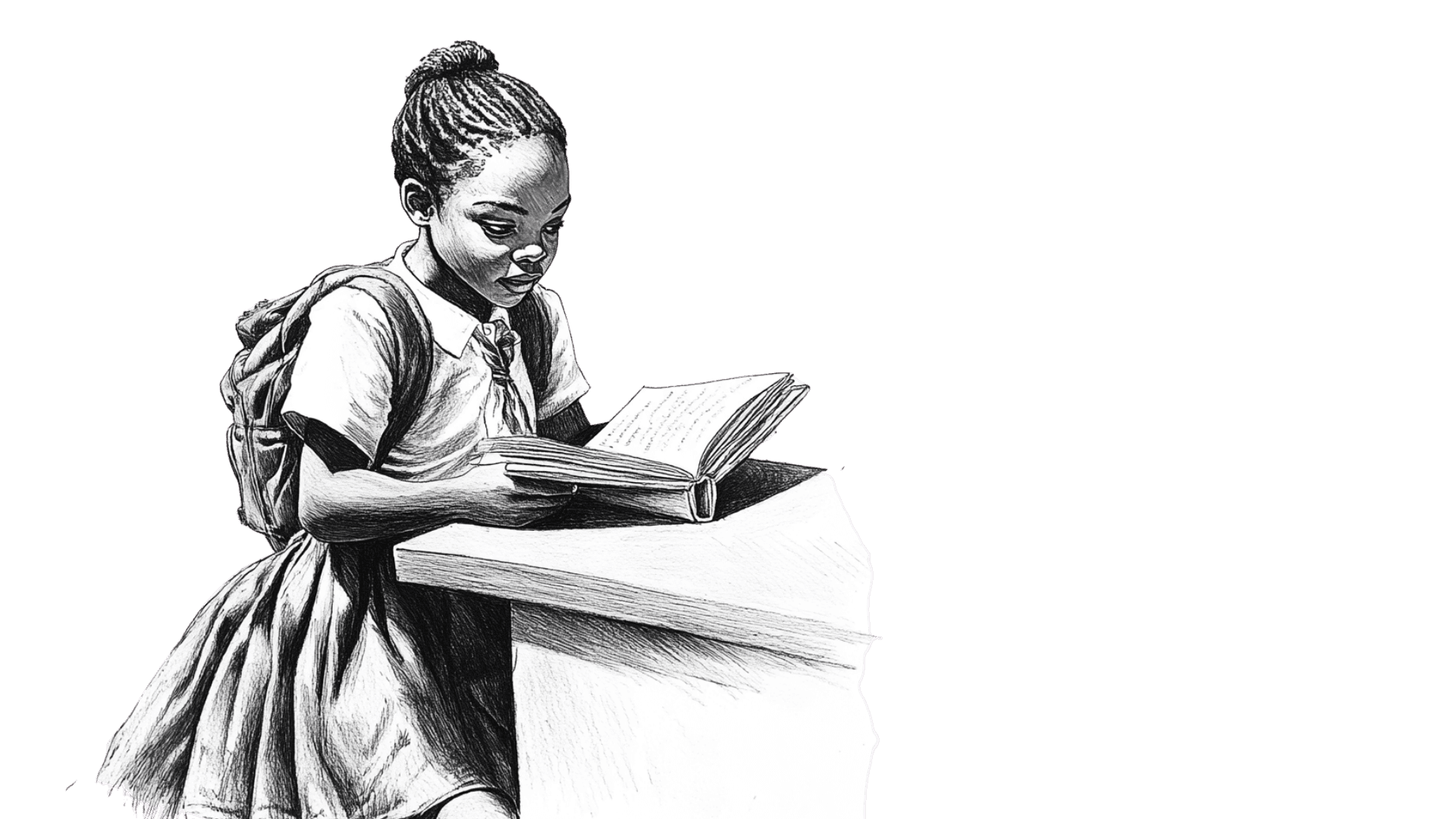
During COVID-19, ministries turned to Education.org for real-time guidance on school closures and reopening.Together, we helped leaders turn knowledge into delivery — building habits that continue today.
We created the only global tracker linking COVID-19 trends with school operations — used by leaders in 90+ countries to guide decisions, from Kenya and the Philippines to Sierra Leone and South Africa.
Our insights — cited over 270 times globally — helped leaders act fast to get children safely back in schools and debunked the myth that reopening schools caused COVID-19 surges.
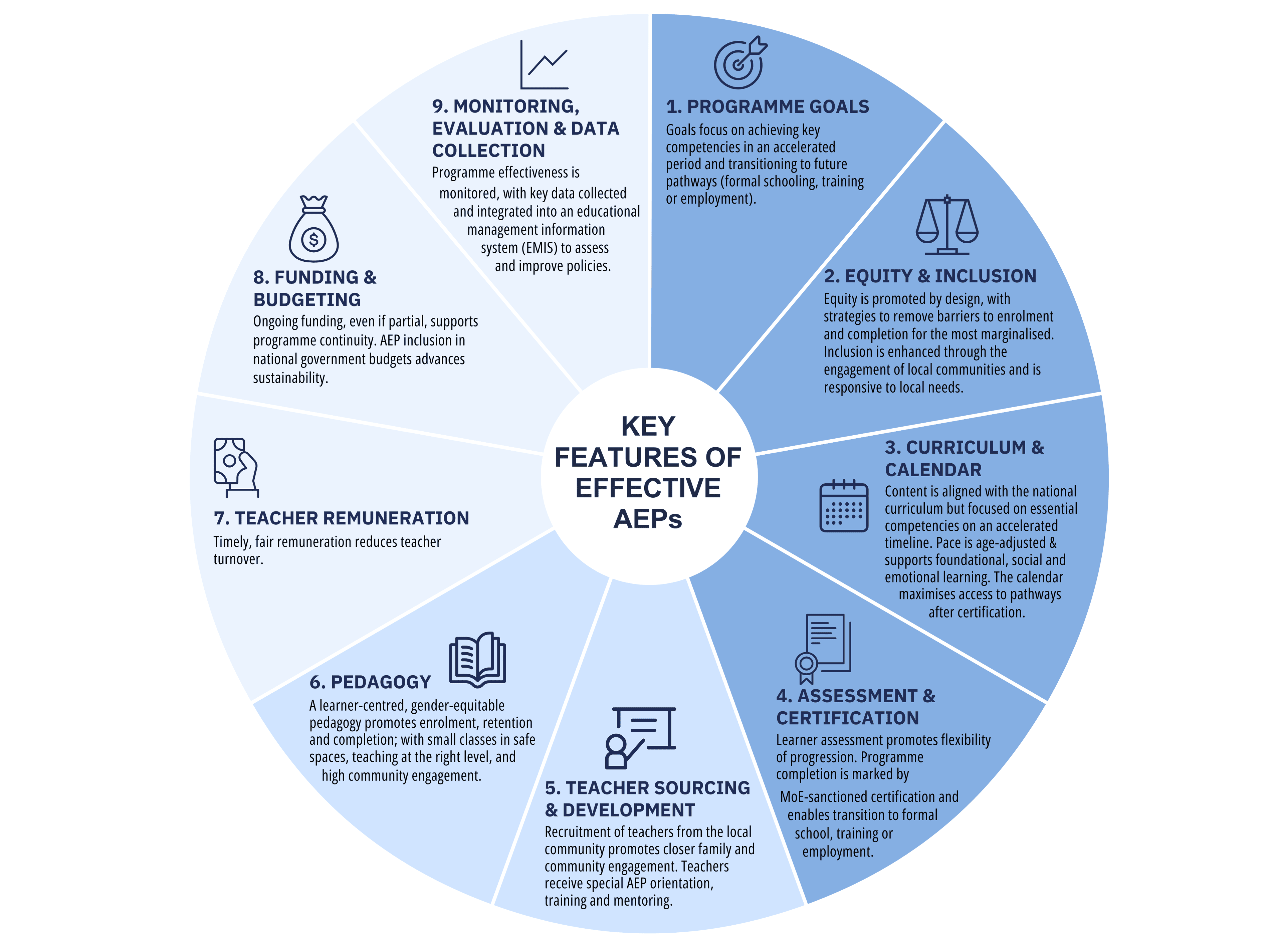
What we learned: what makes accelerated education programmes (AEPs) and learning recovery work — and what holds it back: Using our LIFTED* approach, we analysed 750 sources and distilled the findings into four pages of practical guidance for ministries. We found that the most effective programmes share ten core features — enabled or blocked by system conditions.
Effectiveness depends even more on the enablers governments create for those features to take hold. Strong leadership, coordination, and aligned delivery accelerate success; weak incentives and fragmented systems block it.
*Locally Insclusive Framework to Transform Education Decision Making
Our work shaped tangible government-led actions for 2.3m+ children
KENYA
Based on our evidence-informed guidance and mentorship, Kenya introduced a new strategic framework for out of school children in its national education strategy and developed its first guidelines for accelerated education.
Out-of-school children are now visible in national plans and budgets, with new standards, new budget lines, and heightened accountability across government departments and partners, opening doors for 1.4 m children out of school and many more at risk of dropping out.
SIERRA LEONE
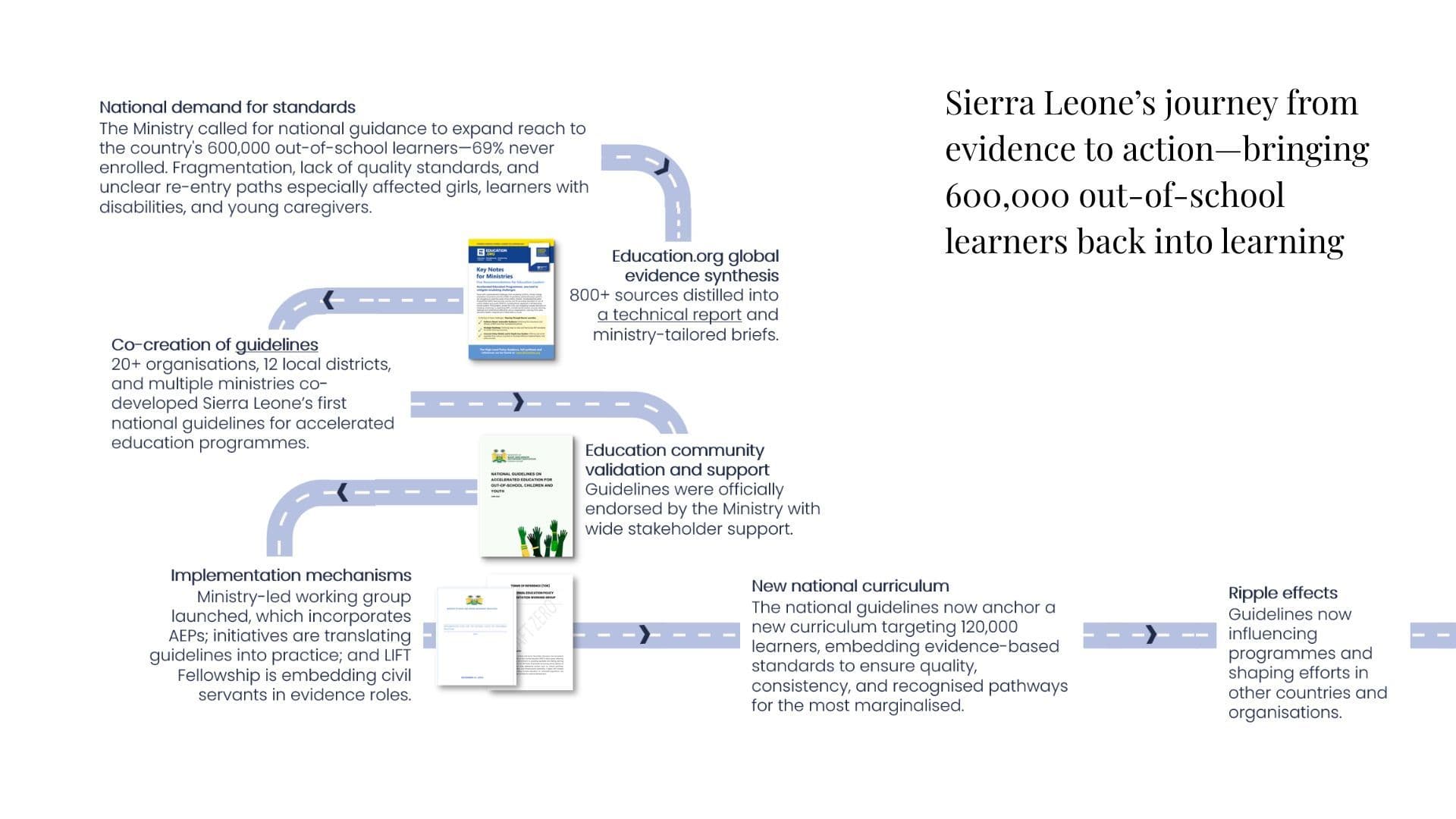
Since 2022, our partnership with the Ministry of Basic and Senior Secondary Education has transformed disconnected programmes into a single, coherent framework and budget for 600,000+ learners.
Over 20 organisations and financing streams are now aligned under one government-led plan. National standards, stronger oversight, a new curriculum, and outcomes-driven financing are now anchored inside the Ministry — supported by two Education.org LIFT Fellows building capacity for sustained, evidence-guided reform.
RIPPLE EFFECTS
The same approach is now taking root in Uganda and Pakistan. Beyond our direct hands-on engagement, our work is informing regional frameworks, guiding philanthropic and aid investments, and influencing how systems worldwide plan, fund, and deliver education for the hardest-to-reach learners.
Our evidence and partnerships are influencing global funding and policy. GPE’s new pillar on out-of-school children—shaped by our work—channeling up to $500M+ and opening doors for 200M learners. The World Bank, Jacobs Foundation, Porticus, and Gates Foundation are embedding our approaches in their global frameworks and investments.
KENYA
Based on our evidence-informed guidance and mentorship, Kenya introduced a new strategic framework for out of school children in its national education strategy and developed its first guidelines for accelerated education.
SIERRA LEONE
Since 2022, our partnership with the Ministry of Basic and Senior Secondary Education has transformed disconnected programmes into a single, coherent framework and budget for 600,000+ learners.
Out-of-school children are now visible in national plans and budgets, with new standards, new budget lines, and heightened accountability across government departments and partners, opening doors for 1.4 m children out of school and many more at risk of dropping out.
Over 20 organisations and financing streams are now aligned under one government-led plan. National standards, stronger oversight, a new curriculum, and outcomes-driven financing are now anchored inside the Ministry — supported by two Education.org LIFT Fellows building capacity for sustained, evidence-guided reform.
RIPPLE EFFECTS
The same approach is now taking root in Uganda and Pakistan. Beyond our direct hands-on engagement, our work is informing regional frameworks, guiding philanthropic and aid investments, and influencing how systems worldwide plan, fund, and deliver education for the hardest-to-reach learners.
Our evidence and partnerships are influencing global funding and policy. GPE’s new pillar on out-of-school children—shaped by our work—channeling up to $500M+ and opening doors for 200M learners. The World Bank, Jacobs Foundation, Porticus, and Gates Foundation are embedding our approaches in their global frameworks and investments.
KENYA
Based on our evidence-informed guidance and mentorship, Kenya introduced a new strategic framework for out of school children in its national education strategy and developed its first guidelines for accelerated education.
SIERRA LEONE
Since 2022, our partnership with the Ministry of Basic and Senior Secondary Education has transformed disconnected programmes into a single, coherent framework and budget for 600,000+ learners.
RIPPLE EFFECTS
The same approach is now taking root in Uganda and Pakistan. Beyond our direct hands-on engagement, our work is informing regional frameworks, guiding philanthropic and aid investments, and influencing how systems worldwide plan, fund, and deliver education for the hardest-to-reach learners.
Out-of-school children are now visible in national plans and budgets, with new standards, new budget lines, and heightened accountability across government departments and partners, opening doors for 1.4 m children out of school and many more at risk of dropping out.
Over 20 organisations and financing streams are now aligned under one government-led plan. National standards, stronger oversight, a new curriculum, and outcomes-driven financing are now anchored inside the Ministry — supported by two Education.org LIFT Fellows building capacity for sustained, evidence-guided reform.
Our evidence and partnerships are influencing global funding and policy. GPE’s new pillar on out-of-school children—shaped by our work—channeling up to $500M+ and opening doors for 200M learners. The World Bank, Jacobs Foundation, Porticus, and Gates Foundation are embedding our approaches in their global frameworks and investments.
In their words
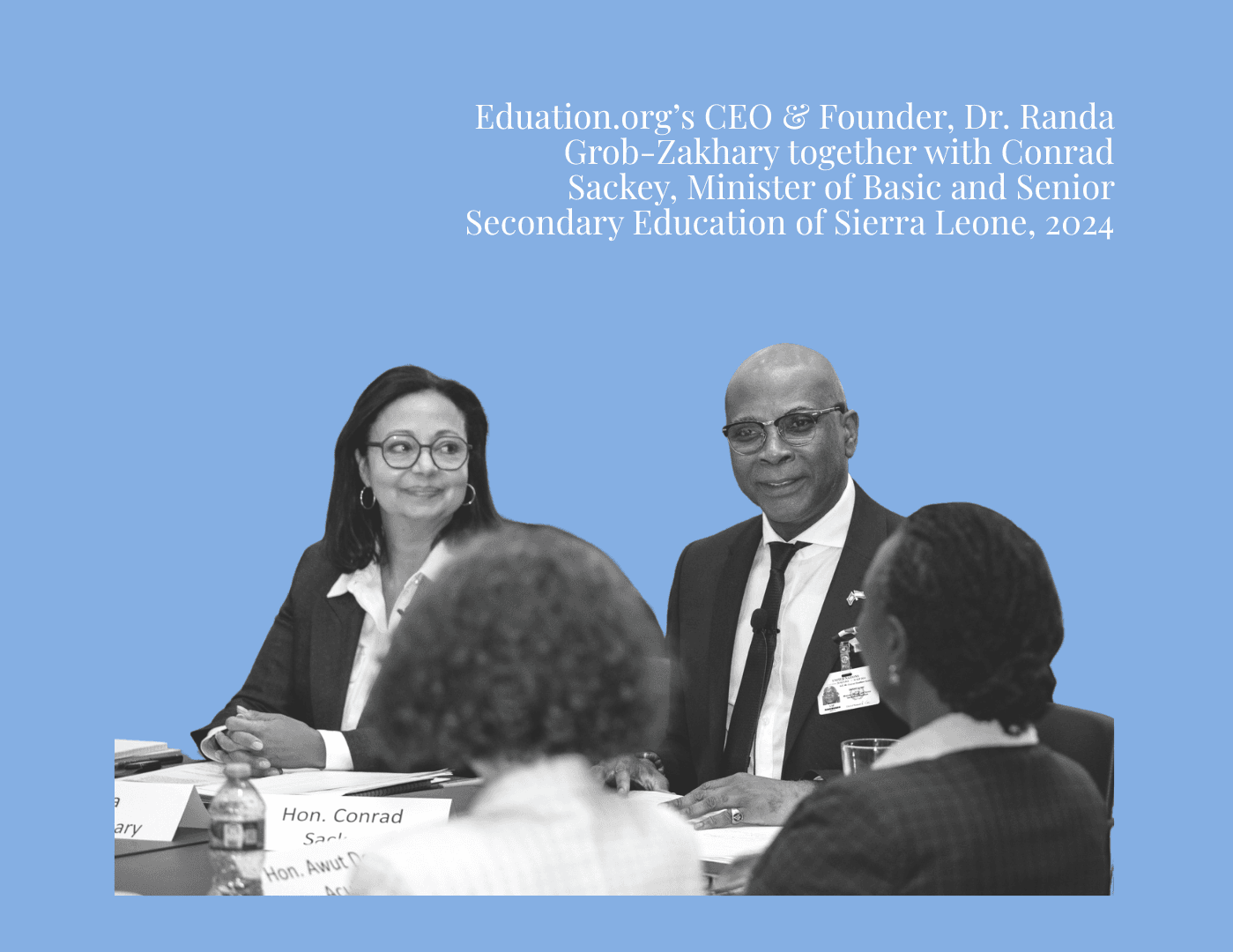
Our Ministry is committed to making decisions based on the best evidence. Accelerated Education can help out-of-school children learn and progress, and now we have guidelines to ensure the quality of these programmes, based on independent analysis and guidance from Education.org. There is no other actor in our sector providing this type of support.
Hon. Conrad Sackey Minister for Basic Education, Government of Sierra Leone
I am glad to see that Education.org seeks to achieve greater visibility of evidence from various sources. Visibility is also Power. This will help us all to navigate tensions of power and ownership, and addressing this is long overdue.
Dr. John Mugo, Executive Director, Zizi Afrique Foundation, Kenya
These guidelines are incredibly timely and serve as an essential tool for our efforts, as we lead a consortium of partners who will implement alongside with the Ministry of Basic and Senior Secondary Education and Sierra Leone’s Teaching Service Commission in a newly designed programme for 60,000 out-of-school children in Sierra Leone.
Patrick Osede Analo, Save the Children Country Director for Sierra Leone
Since 2022, we have supported the Ministry of Basic and Senior Secondary Education to strengthen national leadership and planning for 600,000 out-of-school children, aligning partners and programmes under a single, coherent framework.
- From fragmented pilots to a national framework—and new budget—reaching 600,000+ learners.
- 20+ civil society organisations and financing now aligned under one government-led plan.
- New national standards, stronger oversight, and outcomes-driven budget driving lasting reform.
- Strengthened leadership inside the Ministry is driving evidence-based, budget-backed reform, while two LIFT fellows, embedded in the Ministry, are being trained to lead on evidence use for improved decision-making
We want to learn from similar countries—this helps us improve faster. These guidelines reflect our work, our priorities. That’s why we own them.
Chief Education Officer, Sierra Leone’s Ministry of Basic and Secondary Education
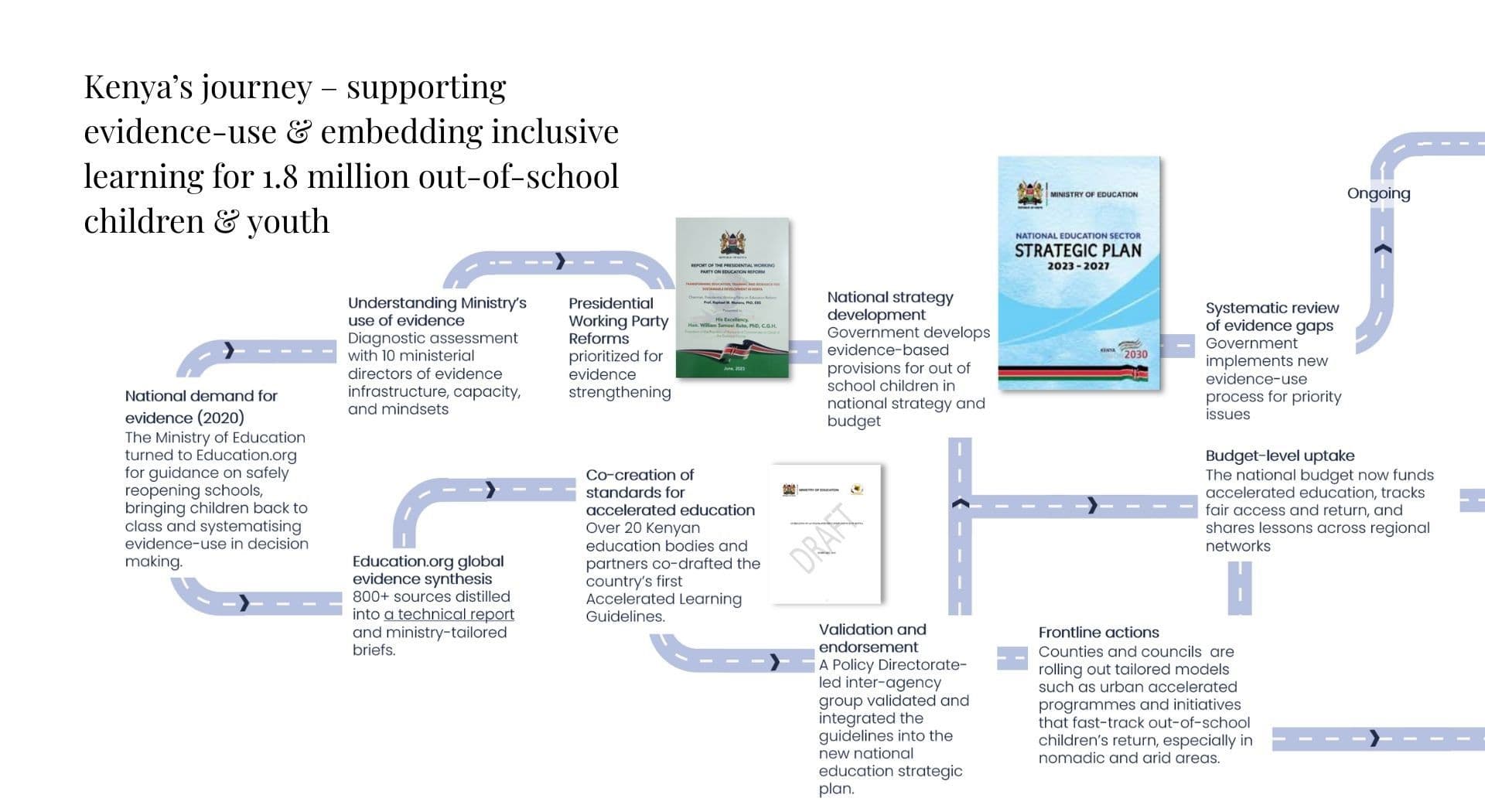
Since 2020, our partnership with the Ministry of Education has supported evidence-led commitments to get an estimated 1.8 million out of school children back into learning, applying our insights on accelerated education to policies and programmes.
- Kenya’s first national framework now makes out-of-school learners a government priority.
- New budget lines now fund accelerated education and equity targets.
- A new evidence culture is taking hold, guiding Kenya’s education reforms—bridging non-formal and formal learning.
- Kenya’s development partners - such as the Gates Foundation and UNICEF are adjusting strategies and funding to reinforce Kenya’s government-led plan.
By together identifying solutions and building the capacity to tackle the identified challenges more effectively with evidence, Education.org is helping us to stand on our feet… This is different from all other partners, who tell you: ‘This is the water; drink it’.
Elizabeth Otieno, Deputy Director of Policy, Ministry of Education, Kenya
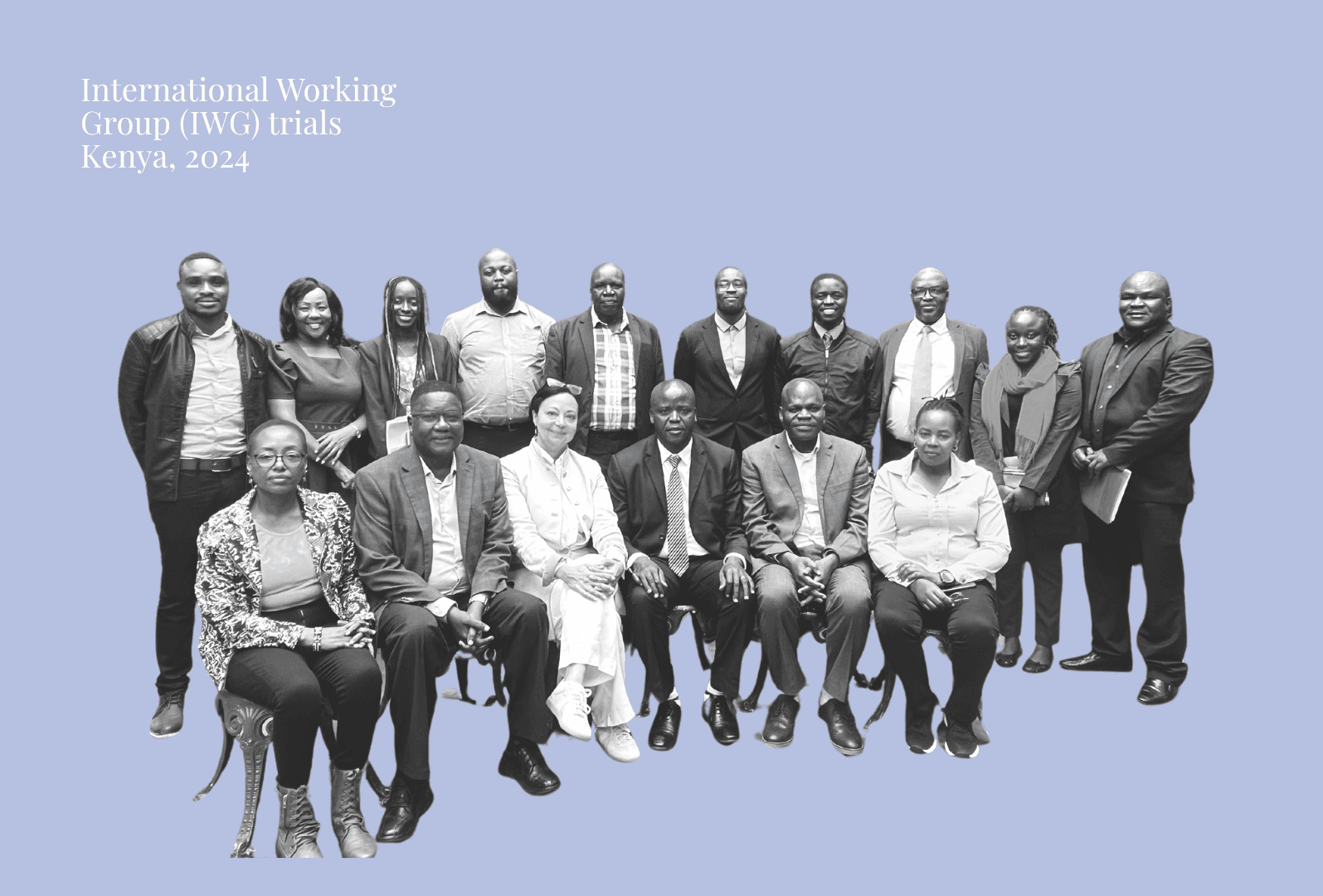
Our evidence base covers 60+ countries; we have formal partnerships with three governments (Kenya, Sierra Leone and Uganda); and we are exploring deepening relationships in nine further countries (Colombia, Liberia, Ghana, Ivory Coast, South Africa, Malawi, South Sudan, Ethiopia and Pakistan).
We welcome collaboration with education leaders around the world, who are interested in accelerating breakthroughs together. Get in touch.

Our impact in numbers
2.3 million
Out-of-school children impacted by our work in Sierra Leone and Kenya
12
National government, NGO and network strategies incorporating guidance and insights from Education.org strategies
75+
Decision makers reporting increased evidence use in their work
15 million
Funding (USD) influenced or redirected based on Education.org’s evidence-based guidance
129
Organisations included in our evidence base due to LIFTED
60+
Countries where evidence is made visible through our LIFTED approach
2.3 million
12
Out-of-school children impacted by our work in Sierra Leone and Kenya
National government, NGO and network strategies incorporating guidance and insights from Education.org strategies
75+
15 million
Decision makers reporting increased evidence use in their work
Funding (USD) influenced or redirected based on Education.org’s evidence-based guidance
129
60+
Organisations included in our evidence base due to LIFTED
Countries where evidence is made visible through our LIFTED approach
2.3 million
12
75+
Out-of-school children impacted by our work in Sierra Leone and Kenya
National government, NGO and network strategies incorporating guidance and insights from Education.org strategies
Decision makers reporting increased evidence use in their work
15 million
129
60+
Funding (USD) influenced or redirected based on Education.org’s evidence-based guidance
Organisations included in our evidence base due to LIFTED
Countries where evidence is made visible through our LIFTED approach