

If you only have one minute:
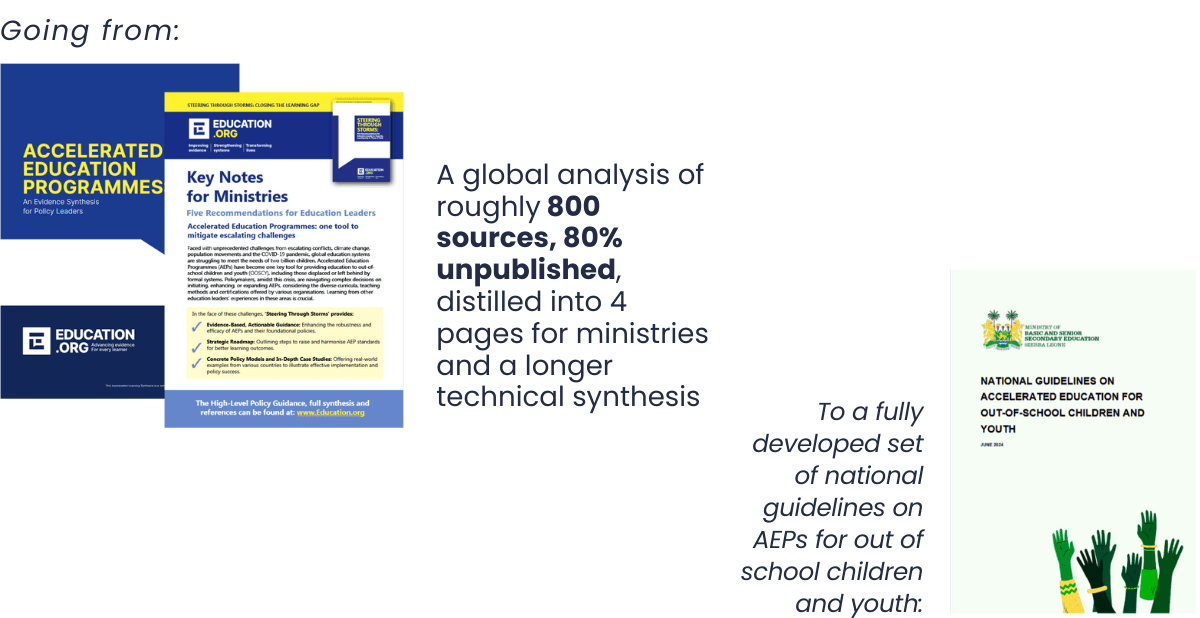
Sierra Leone has embarked on a journey to transform its education system by championing radical inclusion. This national commitment aims to strengthen support for learners who have been most left behind and who face systemic barriers to education, including out-of-school children and youth. As part of these efforts, the Ministry of Basic and Senior Secondary Education partnered with Education.org to co-develop evidence-based guidelines for Accelerated Education Programmes (), grounded in Education.org’s AEPs synthesis. The guidelines provide benchmarks for AEP providers nationwide, including pre-requisites for clear pathways back into formal education, appropriate training, or employment.
Key lessons for similar contexts include:
- Understanding the landscape is essential – Conducting a stakeholder analysis at the outset helps identify allies, resistance points, and policy constraints, creating the foundation for inclusive participation and long-term ownership.
- Involving key actors across national and local levels—including implementers, end users, and civil society—strengthens legitimacy and widens representation.
- Co-creation leads to stronger outcomes – Consultations not only inform and mobilise stakeholders but also surface diverse perspectives..
- Quality comes from collaboration – Drafting the guidelines based on inclusive input helps anticipate challenges and ensures the final product reflects a wide range of voices.
- Validation ensures credibility – Endorsement by Ministry leadership reinforces consensus and supports the uptake of the guidelines.
Translating evidence into policy that improves education delivery and outcomes
Sierra Leone has recently embarked on a journey to transform its education system by championing radical inclusion. This includes a shared commitment to strengthening provisions for out-of-school children and youth, ensuring they receive the targeted support and equal opportunities they need to thrive. This involves tailored approaches to re-engage girls impacted by early marriage, pregnancy, and caregiving, making the guidelines a key tool for gender-transformative education.
To boost these efforts, the Ministry of Basic and Senior Secondary Education approached Education.org to co-develop national guidelines that are now informing national policies’ roll out and active implementation at scale.
The guidelines provide benchmarks and criteria to be used by AEP providers across the country, including pre-requisites for a clear pathway for out-of-school learners to transition back into formal education, appropriate training, or employment.
What were the best practises learned from the process?
Best practise | Result |
Understand the context Stakeholder analysis to assess the policy context, identify potential constraints or opportunities for participation, and pinpoint allies and resistance points. | Creating the conditions for participation, acceptance, ownership, and sustainability. |
Develop a strategy and roadmap Consultation strategy to define the Guidelines' objectives, outline development and validation processes as well as stakeholder engagement plan. | Securing buy-in from the start and allowing for change and adaptation. |
Pre-position for impact Strategic stakeholder engagement, involving those responsible for the guidelines, end users, civil society representatives, and targeting both national and local levels for broader representation. | Strategising contributions based on interest, influence, knowledge, and relevance. |
Consultation & analysis Consultations to gather diverse views, inform stakeholders, raise awareness about the policy guidelines, mobilise supporters, and address bottlenecks. | Enabling a co-creation process based on context awareness and understanding, with a look to the future |
Creation Develop a draft of the guidelines for final review and validation based on the information gathered during consultations. | A mature product informed by inclusive and diverse voices, pre-empting questions and blindspots. |
Validation & uptake Build consensus through a final dialogue with the Reference Group and submit final guidelines to the Ministry’s leadership for endorsement and official launch. | Output is informed by a shared vision and calls attention to areas for action and collaboration. |
The importance of partnering for impact
To ensure a shared understanding of implementation, measurement, and adaptation mechanisms, the guidelines were developed in collaboration with key stakeholders responsible for validating, applying, and evaluating the guidelines, and who played a crucial role in shaping the creation of guidelines for their trial.
In particular, we worked closely with the country’s Chief Education Officer and her team to ensure our insights were effectively contextualised, additional local insights incorporated, and a broad range of stakeholders engaged at the regional and national level to enable policy development and uptake.
The process intentionally focused on gender equality, equity, and inclusion. Guided by the Ministry of Gender and extensive consultations, it ensured that the needs of girls, children with disabilities, and other marginalised learners were incorporated from the initial design stage through to implementation.
Overall, the process included:
- 12 local government authorities provided inputs on the guidelines to ensure their responsiveness to barriers and opportunities of decentralised education processes.
- 20 organisations provided expert input on the guidelines to ensure their robustness and relevance to the local context.
- 4 ministries consulted one-on-one on the guidelines, including the ministries of Technical and Higher Education; Gender and Children Affairs; Social Affairs; and Health.
Guidelines provide a framework, guidelines provide the principles within which we should run AEP's in this country.
Professor Yatta Kanu, Formerly Chief Education Officer, Ministry of Basic and Senior Education, Sierra Leone
What were the results of the process?
- First national guidelines on accelerated education, raising expectations for programmes and providing steering for new investments.
- Strengthened collaboration among implementers such as national and international actors, including FCDO, Save the Children, and EDT.
- Overall, has potential to reach 600,000 out of school children by 2030, and more who are at risk of dropping out and can be supported with retention strategies.
- Embedding gender-responsive and -transformative features crucial for girls’ return to learning, such as flexible scheduling, psychosocial support, and life skills training.
- Planting seeds for stronger ministerial evidence culture and knowledge bridges with implementers.
Our Ministry is committed to making decisions based on the best-evidence. It is clear that Accelerated Education can help out-of-school children learn and progress, and now we have guidelines to ensure the quality of these programmes, based on independent analysis.
Hon. Conrad Sackey, Minister for Basic Education, Government of Sierra Leone
In Sierra Leone, the AEP Guidelines are beginning to shape national priorities and programmes. They are informing two ongoing, government-led processes: UNICEF’s gender-inclusive situation analysis and the design of the Education Above All-funded Out-of-School Children (OOSC) programme.
A Non-Formal Education Working Group has been recently formed and will steer the implementation of the newly approved Non-Formal Education Policy, including supporting the development of an accelerated curriculum. These efforts are further supported by the launch of the LIFT Fellowship in April 2025. Another collaboration between the Ministry and Education.org, the Fellowship is aimed at strengthening long-term civil service capacity. The first cohort of Fellows is expected to begin shortly, helping to embed and sustain these emerging shifts.
These guidelines are incredibly timely and serve as an essential tool for our efforts.
Patrick Osede Analo, Save the Children Country Director for Sierra Leone